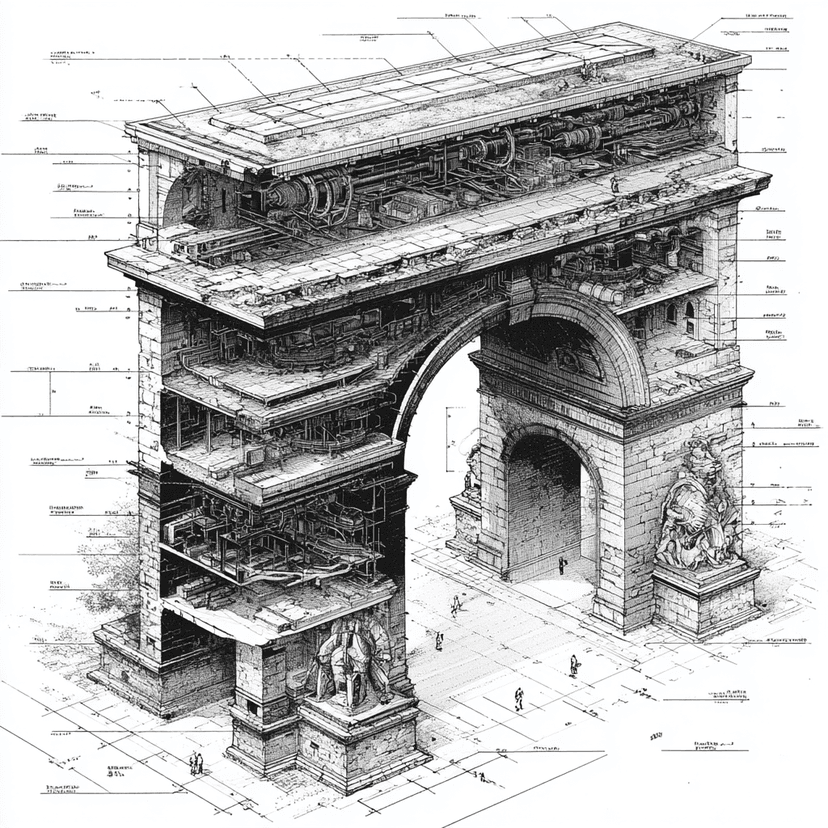
The Hopes
”Hope is by nature an expensive commodity, and those who are risking their all on one cast find out what it means only when they are already ruined.” -- Thucydides, History of the Peloponnesian War 19
In 334 BCE, a twenty-two-year-old in debt crossed the Hellespont into Asia with 32,000 infantry, 5,000 cavalry, a thirty-day food supply, and a war chest of seventy talents. He owed money to friends who had lent him the funds to pay off his father’s creditors. His entire financial position depended on a military gamble against the Persian Empire, the wealthiest and most powerful political entity on Earth.
Before crossing, Alexander the Great had given away most of his personal estates to his generals. When Perdiccas asked what he was keeping for himself, Alexander said: “My hopes.” Perdiccas paused, then said he would be a partner in those. 18
That exchange is the earliest recorded equity fundraise. Every Y Combinator demo day is a more conservative version of this pitch. Alexander distributed tangible assets to recruit talent and commitment, retaining only the intangible claim on future returns. His generals took equity in the venture: a share of hopes, payable if and when the hopes materialized. The structure would be recognizable to any venture capitalist: the founder gives away everything to attract a team committed to the outcome, keeping only the residual claim on success.
The financial pressure produced tactical brutality with business logic. Alexander paid off the majority of his inherited debt by selling the 30,000 citizens of Thebes into slavery after the city revolted. The transaction simultaneously punished rebellion, generated immediate revenue, and sent a message to every other Greek city about the cost of defiance. Dan Carlin framed the invasion as a startup narrative: “Alexander might as well be a company here. This might as well be a father-and-son operation that has disruptive technology. At this point, PersiaCorp is a monopoly. What we have here is a straight-up force deal.” 1
Alexander’s military innovations were not his own. Most came from his father, Philip II of Macedon. The sarissa, a pike roughly 18 feet long, let Macedonian infantry project force twice as far as opponents. The companion cavalry, trained to charge in wedge formation, could penetrate any infantry line. But Philip’s deepest insight was not tactical. “The expansion of his kingdom,” Diodorus recorded, “owed far more to money than to arms.” Philip bribed, subsidized, and purchased allegiance across Greece, creating networks of allies and informants that made military campaigns unnecessary in most cases. His famous remark about walls summed up the philosophy: any wall can be scaled by a donkey carrying gold. 1
Now here is the question this volume exists to answer: Alexander’s empire did not survive Alexander. The kingdoms that succeeded him, Ptolemaic Egypt, Seleucid Persia, Antigonid Macedonia, were fragments, not continuations. His genius was personal: the tactical brilliance, the physical courage, the charismatic authority that held a multinational army together through Afghanistan and India. None of these qualities could be transmitted, delegated, or institutionalized.
When Alexander died at thirty-two, the empire died with him.
Rockefeller’s empire survived Rockefeller. Standard Oil, broken into pieces by the Supreme Court in 1911, produced offspring that are among the largest corporations on Earth more than a century later. The Darius system survived Darius. The Roman camp survived every change of emperor, every civil war, every territorial contraction over four centuries.
The difference between empires that die with their founders and empires that outlast them is the difference this volume maps across three thousand years of evidence. The answer, when it arrives, will not surprise you. The mechanism behind the answer might.
The Pin Factory and the Flat-Pack Galley
”Any intelligent fool can make things bigger and more complex. It takes a touch of genius and a lot of courage to move in the opposite direction.” -- E.F. Schumacher, Small Is Beautiful
In 1776, Adam Smith opened The Wealth of Nations with arithmetic that took two centuries to fully unfold. A single workman making pins could “scarce make one pin in a day, and certainly could not make twenty.” Ten men, dividing the eighteen operations among themselves, could produce 48,000 per day. A 240x increase per worker from task decomposition alone. 2
Smith described a pin factory. He also described, without knowing it, every scaling system that had come before him and every one that would follow.
The Venetian Arsenal had solved the same problem four hundred years earlier. Venice’s shipyard, which at its peak employed 16,000 workers and could assemble a complete galley in a single day, used sequential station construction: the hull moved past fixed stations where specialists added specific components. When Rome decided to challenge Carthage for control of the Mediterranean in 260 BCE, it solved the problem differently and more audaciously. Rome had no navy. Carthage had the finest fleet in the ancient world. The Romans captured a Carthaginian galley that had run aground, reverse-engineered it, and did something no one had attempted: they mass-produced warships.
Roman ships were heavier than Carthaginian ships. Worse in a ramming contest. The Romans accepted this and changed the contest. They invented the corvus, a boarding bridge that locked onto an enemy ship and let Roman marines fight on the enemy’s deck. The Battle of Mylae in 260 BCE, Rome’s first major naval engagement, was a decisive Roman victory. Carthage’s centuries of accumulated naval expertise became irrelevant in a single afternoon.
The principle embedded in the corvus recurs in every scaling story worth studying: the scaling organization does not need to be the best at the incumbent’s game. It needs to redefine the game. Rome could not out-sail Carthage. It could out-build and out-fight Carthage. Ford’s Model T was not the best car available. It was the most producible car available, its design frozen for nineteen years, sacrificing improvement for manufacturability. The competitors who built better cars sold them to thousands. Ford, who built an adequate car at unmatched volume, sold millions. Netflix did not build better video stores. It eliminated video stores. Each innovator was inferior at the incumbent’s game and superior at a game the incumbent had never played.
Steph Curry did this to the NBA. For decades, basketball was a game won in the paint: size, strength, post moves, rebounding. Curry could not compete in that game and did not try. He redefined the contest around three-point shooting at a volume and accuracy that turned the sport’s geometry inside out. Teams that had spent decades developing dominant big men found that their greatest asset, a seven-footer who owned the low block, was now a liability: too slow to guard the perimeter, too expensive to justify against a player who could score from 30 feet. The Golden State Warriors won championships the same way Rome won at Mylae: not by being better at the old game, but by making the old game irrelevant.
In the twelfth century, monasteries across Western Europe discovered the same arithmetic Smith would later formalize. The single altar gave way to multiple side altars, each capable of celebrating Mass simultaneously. Where a monastery had once produced one Mass at a time, it now produced five or ten. The demand driving this redesign came from the aristocracy. Christianity disapproved of shedding blood, which the entire warrior class did for a living. Nobles could not enter heaven without penance and could not perform the penance themselves, because they were busy fighting. The solution: pay monks to pray on your behalf. The monks became, in the historian Diarmaid MacCulloch’s phrase, “a prayer factory for the warrior class.” 17 The medieval equivalent of hiring a wellness consultant so you can keep working 80-hour weeks without examining why.
Then the church extended the scaling logic further. The doctrine of Purgatory, formalized in the thirteenth century, expanded the addressable market for prayer from a niche population of nobles who had committed specific sins to the entire Christian population, all of whom required purification before entering heaven. Purgatory was, in commercial terms, a product extension that converted a niche service into a universal one. The infrastructure of side altars and chantry chapels was already in place. The new doctrine simply increased throughput demand on existing capacity.
The pin factory, the flat-pack galley, the prayer factory: the mechanism is identical across all three. Decompose a complex task into simple, repeatable steps. Assign each step to a specialist. The specialist who performs one operation all day becomes extremely fast at it, never loses time switching between tasks, and makes inefficiencies visible because the single operation is all anyone watches. The output of the system exceeds the output of an equal number of generalists by orders of magnitude. The generalist who performs all eighteen operations is indispensable: remove him and production stops. The specialist who performs one is replaceable: another worker can be trained in days. That shift, from personal dependence to institutional resilience, is the shift from pin-maker to pin factory. And the shift from pin-maker to pin factory is, in compressed form, the shift from Alexander’s empire to Rockefeller’s.
The Architecture of Reach
”The speed of the boss is the speed of the team.” -- Lee Iacocca
In the sixth century BCE, Darius I governed an empire stretching from Libya to India. Dozens of languages. Hundreds of ethnic groups. Multiple religions. Governing it from a single capital was impossible. Governing it through personal relationships, as earlier kings had tried, was impossible at scale.
Darius solved this with a five-part administrative system that anticipated every organizational chart drawn since. The empire was divided into satrapies, each governed by a satrap with wide administrative latitude. The gold daric replaced the babel of local currencies. Standardized weights and measures meant a bushel of grain in Sardis was a bushel of grain in Susa. Satraps filed regular reports to the central administration. Those reports were stored and cross-referenced, creating an institutional memory that survived individual officials. The Royal Road from Sardis to Susa, roughly 2,700 kilometers, was serviced by staging posts where relay couriers exchanged horses and continued without stopping. A message could travel the entire distance in a week. Herodotus wrote that the journey took “exactly 90 days by foot.” By relay, it took seven days. The road was a communication system disguised as a transportation system.
The system had a vulnerability that all delegation systems share: satraps with autonomy could use that autonomy to build independent power bases. Darius addressed this with inspectors called “the King’s Eyes,” who traveled the empire unannounced, auditing satraps and reporting directly to the emperor. The inspectors created a second information channel that the satraps could not control. Expensive. But it prevented the information system from being captured by the people it was supposed to monitor. The King’s Eyes are the ancient world’s internal audit department, except they reported directly to the CEO and could override regional management on the spot. Every modern compliance officer dreams of this authority. None of them get it, which is why compliance departments are the place where bad news goes to be softened into a memo that arrives three quarters too late.
The Mongol Empire scaled the same architecture further. The paisah was a passport, issued in wood, bronze, silver, or gold according to rank. A gold paisah granted the bearer access to any imperial resource: fresh horses, food, lodging, military escorts, the obedience of every official in the empire. The jam was the relay station network, positioned at intervals of roughly 25 miles. Marco Polo described the system and could not contain his amazement. Roughly 300,000 horses were maintained at the stations. The operational cost was enormous. The information advantage was decisive: the khan knew what was happening at the farthest reaches of his empire within days. His enemies, relying on human messengers on foot, took weeks. 15
In 1983, Sam Walton spent $24 million on a proprietary satellite network. He was selling shampoo and socks in rural Arkansas. He had no business buying satellites. But no available data link could synchronize sales data between hundreds of stores and Bentonville headquarters fast enough to support Walmart’s inventory management. The satellite turned Walmart from a collection of independent stores into a single integrated organism. Each store’s sales data flowed to Bentonville, where it was aggregated, analyzed, and used to generate replenishment orders dispatched on optimized truck routes. Sell, report, analyze, replenish, sell. The speed of that loop was the advantage. A competitor with the same product at the same price but a slower loop would have either empty shelves or excess inventory. Walmart had neither. 3
The Royal Road, the Mongol jam, and the Walmart satellite cost far more than their contemporaries considered reasonable. In every case, the critics evaluated the cost of the system rather than the cost of operating without it. The empire that communicates faster governs better, because faster communication enables faster coordination, and faster coordination enables faster response. Darius knew this in 500 BCE. Walton proved it again in 1983. The technology changed. The principle did not. If you have been in a meeting where someone said “that infrastructure investment doesn’t make sense at our current scale,” you were listening to the people who laughed at Walton for buying satellites.
Chokepoints and Cost Sheets
”In business, I look for economic castles protected by unbreachable moats.” -- Warren Buffett 21
The Nabataeans charged a quarter of all goods passing through their territory. They did not own the goods. They did not manufacture them. They did not transport them. They controlled the chokepoints: the oases where caravans refueled, the passes through the mountains, the wells in the desert where water was life or death. Caravans of 1,000 to 12,000 camels moved incense, spices, and luxury goods from Arabia to the Mediterranean. The Nabataeans captured a quarter of that value by controlling the points where alternatives did not exist.
When Rome sent Prefect Aelius Gallus to bypass the middlemen by finding a direct route to the incense source, the Nabataeans assigned a guide named Sylaeus. Sylaeus faced a delicate challenge: appear to cooperate with Rome while ensuring the expedition failed. He led the Roman army through waterless stretches that killed thousands, past poisoned wells, along routes designed to maximize casualties. The expedition collapsed. The Nabataean monopoly endured for another generation. It is, in compressed form, the same move every platform company plays when a regulator comes asking questions about competition. Sylaeus would have thrived in corporate strategy. Lead the competitor into the desert. Appear helpful. Express concern at every setback. Maintain plausible deniability throughout. The technique has aged well.
In 1872, John D. Rockefeller sat across from railroad executives and laid out the South Improvement Company contract. The railroads would double freight rates. They would not charge the combination the increase. They would give the combination the increase collected from competitors. They would spy on competitors’ shipments, reporting every barrel to Standard Oil. The contract was discovered and revoked within months. But the logic shaped Standard Oil’s strategy for the next thirty years: own the chokepoints, tax the competitors who pass through them, use the revenue to subsidize your own operations, use the information gathered at the chokepoints to anticipate and preempt competitive moves. 5
Andrew Carnegie ran his steel empire on a single metric: cost per ton. He knew his costs to the fraction of a cent. His competitors could not tell him their costs to within two dollars per ton. That information asymmetry was more valuable than any technological advantage. “We made the naturally rich man poor and the naturally poor man rich,” Carnegie observed, meaning the manager who inherited a good operation but let costs creep was punished, while the manager who inherited a bad operation but drove costs down was rewarded. Captain Bill Jones, Carnegie’s greatest superintendent, drove costs below $20 per ton through grinding process improvement while competitors charged $70. 6
Carnegie’s full vertical integration, assembled by Frick, made the cost advantage structural rather than operational. From crude ore to finished steel, there was never a price, profit, or royalty paid to an outsider. Carnegie could shade rails to $65 per ton when others asked $70, because Jones could make them at $36. The gap between cost and price was Carnegie’s margin. The gap between Carnegie’s cost and the competitor’s cost was Carnegie’s moat. When Carnegie needed to break the Pennsylvania Railroad’s freight monopoly, he did not negotiate. He secretly bought a dilapidated railroad, the Pittsburgh, Chenango & Lake Erie, and rebuilt it into a competitive alternative. The threat of a competing route forced rate reductions. 7
The Nabataeans controlled the physical chokepoint. Rockefeller controlled the industrial chokepoint. Bernard Arnault’s LVMH controlled the brand chokepoint: “If you control your factories, you control your quality. If you control your distribution, you control your image.” 8 Google controls the search interface through which consumers find the internet’s content. Apple controls the App Store through which developers reach iPhone users. The mechanism is identical: tax the flow at the point where alternatives do not exist. The Nabataeans discovered this in the desert twenty-three centuries ago. The rent collected at the chokepoint is proportional to the volume of transactions passing through it. Build the chokepoint, and the volume builds the rent.
The Standardization Wager
Charlie Munger said the cash register “did more for human morality than the congregational church.” 10 The statement is deliberately provocative and entirely serious. Before the register, retail theft was a function of opportunity: the clerk who handled cash all day, with no systematic record, faced constant temptation that only personal honesty could resist. The register made dishonesty expensive by increasing the probability of detection. It did not make people more honest. It made theft more visible.
The register is a scaling technology disguised as an accounting tool. The store owner who supervised one clerk personally could detect theft through observation. The store owner with fifty clerks across ten locations could not. The register replaced personal supervision with systematic monitoring, enabling control across distances and volumes that personal relationships could never govern.
Marcel Telles found the same problem at Brahma brewery. Quality consultants tested bottles from every plant on the same day. Each tasted different. They tested bottles from the same plant at different hours. Those tasted different too. “The chief brewer considered himself an artist. Telles considered him a problem.” The brewer’s artistry was a form of non-standardization: each batch was unique because each reflected the brewer’s judgment in the moment. Telles replaced artistry with process. The resulting beer never matched the artist’s best batch. But it was identical to every other batch, every day, at every plant. The artist’s best batch was unreplicable. The process’s average batch was infinitely replicable. Scaling requires the second. 11
Hip-hop understood this before Silicon Valley did. In the early 1990s, Dr. Dre and Death Row Records ran on the genius-dependency model: every hit required Dre’s ear, Dre’s studio time, Dre’s judgment. The output was extraordinary and completely non-scalable. When Dre left, the machine stopped. Compare this to what Berry Gordy built at Motown three decades earlier: a songwriting system (Holland-Dozier-Holland), a house band (the Funk Brothers), a quality control process (Friday morning playback meetings where songs had to pass audience testing before release), and an artist development pipeline that turned teenagers from Detroit into global acts. Gordy built a pin factory for pop music. The product was consistently excellent precisely because it did not depend on any single genius being in the room. Dre’s best beats may have been better than Motown’s best singles. But Motown produced 79 records that reached the Top Ten in an eight-year stretch, a hit rate that no genius-dependent model has ever matched.
In the second millennium BCE, every writing system in the world required years of specialized training. Egyptian hieroglyphs employed hundreds of symbols. Cuneiform demanded roughly 600 signs. The Phoenicians reduced writing to 22 letters. A merchant could learn the system in weeks. A child could learn it in months. Every alphabet currently in use, Latin, Greek, Cyrillic, Arabic, Hebrew, descends from that Phoenician system. The standardization succeeded because it lowered the barrier from years of professional training to weeks of basic instruction. Literacy ceased to be a guild skill and became a public utility.
In Machiavelli’s Art of War, the character Fabrizio describes the Roman camp: every legion laid its camp in exactly the same configuration, regardless of terrain, season, or campaign. Streets the same width. Tents in the same positions. Latrines in the same location. A soldier transferred from one legion to another, or from one end of the empire to another, could navigate his new camp in the dark. Machiavelli’s phrase: “a movyng Citee, the whiche where so ever it goweth, carrieth with it the verie same waies.” The standardized layout eliminated the cognitive load of orientation. A soldier arriving at a new camp did not need to learn where anything was. He already knew. That mental energy was freed for training, maintenance, vigilance. 16
McDonald’s runs on the same logic. Every restaurant has the same layout, the same equipment in the same locations, the same processes in the same sequence. When Richard and Maurice McDonald slashed their menu from 25 items to 9, cut the burger price in half, and eliminated all substitutions in 1948, they were building a Roman camp for hamburgers. By removing the variables, they removed the wait. By removing the wait, they removed the primary reason customers chose competitors. Sam Walton took this further with Every Day Low Pricing. He asked Bernie Marcus: “Why do you continue to run sales? Don’t you run out of merchandise?” Promotional pricing created variability in prices, inventory, staffing, customer expectations. EDLP eliminated the variability. Same prices, same stock, same experience, everywhere, every day. 14
”Civilization is not inherited; it has to be learned and earned by each generation anew; if the transmission should be interrupted for one century, civilization would die, and we should be savages again.” -- Will Durant, The Lessons of History 20
Durant’s insight is the philosophical spine of standardization: the entire point of process is transmission across generations. Without it, every generation starts from zero. The Roman camp, McDonald’s playbook, the Walmart operations manual: each is a mechanism for transmitting organizational knowledge so that the next generation does not have to rediscover it. The Phoenicians understood this twenty-five centuries before Durant wrote it down. Reduce the barrier to transmission, and civilization compounds. Raise the barrier, and each generation reinvents the wheel.
But standardization carries a cost that its advocates rarely advertise. Somewhere in every standardized system, an artist was fired. The Brahma brewer who considered himself an artist was not wrong about his best batch. He was wrong about which metric mattered. The artisan ship-builder constructed a better individual ship than the Roman mass-production system. The artisan brewer produced a better individual batch. The standardized system produced a more reliable average, and reliability, not peak performance, is what scales. If you have ever had a conversation about whether to hire a brilliant but unpredictable person or a reliable but unremarkable one, you were debating the standardization wager. The answer depends on whether you are building a pin factory or looking for a pin-maker.
The Drift
”All men can see the tactics whereby I conquer, but what none can see is the strategy out of which victory is evolved.” -- Sun Tzu, The Art of War
Sun Tzu was describing the invisible layer where outcomes are determined. The drift operates on that same invisible layer, except it works against you.
Pepi II ruled Egypt for more than sixty years, the longest documented reign in ancient history. During those decades, regional governors, the nomarchs, had been appointed by the pharaoh and served at his pleasure. Gradually, the positions became hereditary. Sons succeeded fathers. Local dynasties formed. The nomarchs collected taxes but forwarded decreasing amounts to the central treasury. They maintained armies but owed decreasing loyalty to the center.
The process was slow, invisible, and nearly impossible to reverse without confrontation. The central authority delegates power to a regional agent. The agent uses the delegated power to build a local power base. The local power base becomes self-sustaining. The agent begins to operate independently. The center, unwilling to confront the agent, accommodates the independence. The accommodation sets a precedent. Other agents notice. The process accelerates.
The Lamont confrontation at the House of Morgan in 1931 was Pepi’s drift compressed into a single banking partnership. Jack Morgan, son of J. Pierpont Morgan, had inherited leadership of the bank. Thomas Lamont, the bank’s most capable partner, had accumulated de facto power over decades. When Lamont confronted Morgan directly, “this letter of September 25, 1931, marks the moment when the House of Morgan ceased operating as a family bank.” Hereditary authority yielded to earned authority, exactly as Pepi’s appointees had been displaced by local dynasties thirty-five centuries earlier.
Esarhaddon, king of Assyria, faced the succession problem every empire-builder faces: multiple capable sons, one throne. His solution was division: one son king of Assyria, another king of Babylon. The logic seemed sound. Each son would have a kingdom. Neither would need to destroy the other. The split backfired. The two kingdoms competed for resources, attention, and prestige. The rivalry consumed energy that should have been directed outward. The division designed to prevent civil war produced civil war. The civil war ushered in Assyria’s final chapter.
The pattern recurs whenever someone tries to solve the succession problem by creating parallel structures. The logic of division assumes the divided parties will cooperate. The reality is that parallel structures compete: for budget, for talent, for the leader’s attention, for the right to define direction. If you have watched a CEO create co-presidents to avoid choosing between two executives, you have watched the Esarhaddon mistake in real time. The co-presidents compete for the CEO’s role, divide the organization into camps, and produce a succession crisis worse than the one the co-presidency was designed to prevent. The organizational consulting industry has made billions helping companies design co-leadership structures. It has made billions more helping them unwind the disasters that follow. A cynic might observe that the consultants have achieved what Esarhaddon could not: a self-financing perpetual cycle.
Britain required one-eighth of the entire Roman Imperial Army to defend: roughly 40,000 soldiers stationed in a province that generated modest economic returns. Any force large enough to hold Britain against the Picts, the Irish, and native resistance was also large enough to march on Rome. Several garrison commanders tried exactly that. The province was simultaneously a drain on imperial resources and a threat to imperial stability.
The Songhai Empire, the largest state in West African history, “burst like a bubble from a single puncture.” 12 When the Moroccan army crossed the Sahara in 1591, the empire did not retreat to a defensible core. It shattered. “Where a single state had existed, now countless small kingdoms reasserted their freedoms.” Askia Muhammad’s success had come from a pluralistic coalition: competing factions united under shared governance. The structure required continuous maintenance. Each faction had to feel represented. The maintenance was the empire. When the maintenance stopped, so did the empire.
An empire is a collection of distinct groups held together by force, institutional inertia, or a ruler’s personal authority. When the holding mechanism fails, the components resume their independent existence. A nation is a collection of people who identify as a single group. When a nation’s institutions fail, the people reorganize under new institutions but remain a single group. Every conglomerate that breaks up after a succession crisis or an activist challenge is a Songhai fragmentation. The component businesses are more valuable independently than together. The conglomerate’s coordination cost exceeds its coordination benefit. The breakup releases the trapped value. If your company’s divisions would be worth more as independent entities than as parts of the whole, you are not running a company. You are running a coalition, and coalitions dissolve the moment the coalition-maintenance fails.
The Trap
”Tradition is not the worship of ashes, but the preservation of fire.” -- Gustav Mahler
The difference between preserving fire and worshipping ashes is the difference between Costco and Bagan. Both are locked into sacred commitments. One engineered an architecture to sustain the fire. The other built temples over the ashes until the kingdom ran out of money to defend itself.
By the late thirteenth century, the kingdom of Bagan in present-day Myanmar had a problem no king could solve. The Buddhist church owned 63 percent of the kingdom’s land and the majority of its gold and silver. The land was tax-exempt. The church acquired more property each year through royal donations and private bequests. The kingdom’s tax base shrank as the church’s holdings grew. 12
The trap was structural. The kings of Bagan derived their legitimacy from Buddhism. Every king demonstrated piety by building temples and endowing monasteries with land. The more pious the king, the more land the church received. The more land the church received, the less revenue the king collected. The less revenue the king collected, the weaker the kingdom became. The weaker the kingdom became, the more the king needed divine legitimacy, which required building more temples and donating more land.
No king dared seize the church’s land, because the act would have destroyed the religious legitimacy on which his authority rested. The unarmed monks were untouchable, and their untouchability was the mechanism of the kingdom’s decline. When the Mongols arrived in 1287, Bagan lacked the resources to mount an effective defense. The temples survived. The kingdom did not.
Costco’s $4.99 rotisserie chicken, sold below cost for decades, is a benign version of the Bagan trap. The price is sacred, and sacredness is expensive. Costco processes 500 million chickens per year, 130 million sold as rotisserie chickens. Only four or five chicken processors operate at the scale Costco requires. That supplier concentration created vulnerability and limited negotiating power. Costco’s solution was vertical integration, but executed with a caution that Ford and Carnegie would have recognized. Before building its own processing plant, Costco rented 100 percent of an existing Alabama facility. For years, Costco operated the rented plant, learning every aspect of the business. Only after mastering operations through the rental did Costco build its own facility from scratch. The rental was tuition. The owned facility was the graduation. 9
The difference between Costco and Bagan is not the trap. Both are locked into commitments that constrain their economics. The difference is architecture. Costco chose its trap deliberately and structured its entire business to absorb the cost: the chicken brings people through the door, the warehouse layout ensures they walk past everything else on their way to the chicken counter in the back. The chicken counter is always in the back. You have to pass the 80-inch televisions, the Kirkland wine, and the 48-pack of paper towels on the way. This is not an accident. It is Costco’s version of a casino floor layout: you came for one thing, you leave with a cart that costs $300, and somehow you feel grateful. The $4.99 chicken is the most profitable loss in American retail. The kings of Bagan inherited their trap and had no such architecture. If your organization has a sacred commitment, a price point, a product feature, a cultural promise that cannot be changed without destroying the thing that makes you legitimate, you are inside a version of the Bagan trap. The question is not whether to escape it. You probably cannot. The question is whether you have built the architecture to fund it, or whether, like Bagan, you are hoping the Mongols take their time.
Ashurbanipal, the last great king of Assyria, built the first universal library: over 30,000 clay tablets. He was the most cultured ruler of his age and among the most brutal. His military campaigns eliminated enemies entirely: populations deported, cities razed, kingdoms erased. The elimination worked in the short term. Each destroyed enemy removed a threat. But each destruction created a vacuum, and vacuums attract new occupants who arrive with deeper hatreds and greater motivation. The empire that destroys its opponents completely must fight a perpetual war against an endlessly regenerating threat. The empire that defeats its opponents partially and incorporates them, as Rome and Persia both did, converts enemies into subjects and subjects into allies. Ashurbanipal built the world’s first library and destroyed civilizations with equal enthusiasm. The patron saint of everyone who reads books about leadership and then fires their entire team.
The Invisible Infrastructure
”We shape our buildings; thereafter they shape us.” -- Winston Churchill
After the Roman legions departed Britain in 410 CE, the consequences became visible in mundane details. Pottery produced in Britain “drastically reduced in variety.” Iron production plummeted. “Around the year 350, the Roman sewers in Canterbury started clogging up and no one bothered to clear them.”
The sewers were not destroyed. They were not sabotaged. They were neglected. The institutional capacity to maintain them, the administrators who scheduled maintenance, the workers who performed it, the tax revenue that funded it, had evaporated with the departure of the Roman system. The physical infrastructure remained. The organizational infrastructure that kept it functioning did not. Churchill was talking about the House of Commons chamber, but the principle runs deeper than architecture. We build the systems. Then the systems constrain us. And when we stop maintaining them, the constraint does not vanish. The building does not reshape itself. It rots.
Every corporate acquisition runs this risk. A company buys another company for its technology, its customer relationships, or its brand. Those assets are visible on the balance sheet. The organizational capital that makes them productive, the engineers who know the code, the salespeople who know the customers, the culture that motivates the work, does not appear on the balance sheet. When the acquirer disrupts the organizational capital through layoffs, reorganizations, or cultural imposition, the acquired assets decay the same way Canterbury’s sewers decayed once the maintenance schedule disappeared.
“When I started Amazon, I didn’t have to develop a payment system,” Jeff Bezos said. “It already existed, called the credit card. I didn’t have to develop a transportation system. All this heavy lifting infrastructure was already in place.” Bezos built Amazon on infrastructure that other people had paid for: the credit card network, the postal service, UPS, FedEx, the internet backbone. Each represented billions of dollars of someone else’s investment. Bezos used them as foundations, paying marginal cost while capturing the value that coordination across the systems could generate. 13
Infrastructure creates the possibility of the next layer. The credit card enabled Amazon’s payment system. The payment system enabled one-click purchasing. One-click enabled Prime. Prime enabled same-day delivery. Same-day delivery enabled the grocery business. Each layer was only possible because the preceding layer already existed. Then Bezos executed the Ford-Carnegie play: he became infrastructure himself. Amazon Web Services provided computing infrastructure on which other companies built their businesses. Amazon Fulfillment handled third-party logistics. Amazon Pay processed transactions. Companies that built on Amazon’s infrastructure became, structurally, tenants. They paid rent as fees, and their dependency increased with every year on the platform.
Pachacuti Inca Yupanqui built the Inca Empire’s infrastructure on a different principle: visible abundance. In the Mantaro Basin alone, 3,000 storehouses held 170,000 cubic meters of capacity: food, textiles, weapons, tools, raw materials. The storehouses were placed on hilltops visible from the valley floor. Deliberately visible. They served three functions simultaneously: logistical supply for armies on campaign, disaster relief for crop failures, and psychological control. The subject who contemplated rebellion had to weigh not just the military cost but the loss of the state’s logistical safety net.
Amazon’s fulfillment centers serve the same three functions as the Inca storehouses. They enable the delivery speeds that are Amazon’s primary competitive advantage. Their distributed network ensures the failure of any single facility does not disrupt the system. And the guarantee that anything you want can arrive tomorrow changes your relationship to purchasing in a way that makes alternatives feel inadequate. The storehouses made loyalty rational in the Mantaro Basin. Prime makes loyalty rational in the twenty-first century.
Emperor Wu of Han solved the infrastructure problem through distribution rather than concentration. He needed tens of thousands of horses for cavalry against the steppe nomads. The centralized solution would have been imperial horse farms. Wu chose the distributed solution: loan breeding horses to farmers, receive foals in return, exempt horse-providing families from military service. The cost was distributed across millions of households, each bearing a tiny fraction. A centralized farm could be destroyed by a single raid or epidemic. The distributed network, spread across a continent, could not be destroyed by any localized event. The Linux kernel is maintained by the same architecture: thousands of developers, each contributing a small portion, with no single failure point that can destroy the project.
The Polynesian expansion across the Pacific, the most extensive colonization before the European age of exploration, solved the infrastructure problem through modularity. Polynesians colonized islands scattered across 16 million square miles using what archaeologists call the “colonization package”: food crops (taro, yam, breadfruit, coconut), domestic animals (pigs, chickens, dogs), tool materials, and the knowledge to cultivate, build, and navigate. Each canoe carried a complete set. Each landing produced a viable colony regardless of what the island offered naturally. The package was a franchise kit. Each colony was a complete copy of the original, capable of launching its own canoes and planting its own colonies. McDonald’s runs on the same model: each restaurant receives a complete operating package. A new franchise does not need to invent the hamburger. It needs to execute the package.
The invisible infrastructure, the organizational capital that keeps physical capital functioning, is the layer that separates empires that endure from empires that crumble when the founder stops paying attention. Canterbury’s sewers are the warning. The Inca storehouses are the aspiration. The difference between them is not engineering. It is maintenance.
The Empire-Builder’s Diagnostic Kit
”Plans are worthless, but planning is everything.” -- Dwight D. Eisenhower
You have encountered the conventional advice on scaling. It appears in every operations textbook, every management consulting deck, every book with “growth” in the title. It goes like this: build processes early. Document everything. Hire ahead of the curve. Plan your succession. Create playbooks. Standardize.
The advice is not wrong. It is aimed at the wrong layer of the problem. Scaling failures are not process failures. They are architecture failures. The advice tells you to build more road. The real question is whether you are building roads or building the system that makes roads self-maintaining. Process advice operates on the operational layer. The patterns in this volume operate on the structural layer: the relationship between the organization, its commitments, its information flows, and the dependencies that sustain them. Individual-level interventions (be more aware, plan better, document more) are the tools that already failed for every empire documented in these pages.
The advice fails for the same reason that telling an addict to “just stop” fails. The problem is not a shortage of willpower or knowledge. The problem is structural: the addict’s environment, incentives, and social feedback loops are all configured to produce the behavior the advice tells them to stop. Scaling failures work the same way. The operator is not failing to follow the advice. The operator is inside a system that makes the advice inapplicable.
The following seven practices are derived from operators who actually broke through, and each one addresses a structural failure mode that no amount of process documentation could have caught. Eisenhower’s distinction applies: these practices are not plans. They are planning. The value is in the diagnostic thinking, not in the specific answers.
The Darius Audit. Darius governed the largest empire the world had yet seen through five layers: delegation structure, common standards, measurement system, reporting cadence, and institutional memory. Most operators know what their organization does. Almost none can articulate which of these five layers enables them to do it at scale. The practice: map your organization against Darius’s five layers. Where you find one missing, you have found your scaling ceiling. The missing layer is not a nice-to-have. It is the constraint that will break you at the next order of magnitude. The reason this works where “build processes” fails: it forces a diagnosis of which specific layer is absent, rather than blanket process improvements to a layer that may already be adequate. Most scaling failures come from a single missing layer, not from general process weakness. The company with excellent delegation but no institutional memory will lose everything when its senior leaders depart. The company with excellent standards but no reporting cadence will discover problems only after they have metastasized. Darius built all five. Which one are you missing? The symptom of a missing layer is a scaling ceiling that masquerades as a hiring problem. You keep adding people and the output does not increase proportionally. You blame the new hires. You churn through two rounds of replacements before someone asks whether the problem is the people or the system they are being dropped into. It is almost always the system.
The Carthage Test. Carthage outsourced its military for the same reason companies outsource engineering: citizens preferred commerce to conscription, and the political class avoided the backlash that drafting its own people would have produced. The arrangement lasted centuries and produced some of the finest military forces in the ancient Mediterranean. It also collapsed catastrophically when the mercenaries died at Cannae and replacements had to be recruited from distant provinces, and collapsed again when the pay stopped and the Mercenary War of 241 BCE nearly destroyed Carthage from within. For every function your organization outsources, answer one question: if this supplier disappeared tomorrow, could you perform this function yourself within 90 days? If the answer is no, you have made the Carthaginian bet. The test is not whether you should outsource. You probably should. The test is whether the outsourcing has crossed from operational convenience into structural dependency. Convenience means you chose the vendor because they are better. Dependency means you can no longer do the work without them. The symptom of structural dependency is a strange incuriosity about how things work. Your team can describe what the vendor delivers. Nobody can describe how the vendor produces it. When you lost the ability to evaluate the work, you lost the ability to detect when the quality degrades. The vendor knows this before you do. Which of your outsourced functions have you lost the internal capability to even evaluate, let alone perform?
The Pepi Clock. Delegated authority becomes independent authority on a timeline measured in years, not months. Pepi’s reign lasted sixty years, and by the end, his appointed governors had become hereditary lords. The practice: for every leader who has held a regional or functional role for more than three years, ask whether headquarters could replace them without operational disruption. If the answer is no, the drift has already occurred. You are not managing a subordinate. You are negotiating with a peer who happens to report to you on an org chart. The Roman solution, rotation, is expensive and disruptive. Pepi’s solution, denial, is fatal. The practice is not to rotate everyone. The practice is to know which positions have drifted and to make the rotation-versus-accommodation decision deliberately rather than by default. The symptom of drift is a leader whose departure would be described internally as “catastrophic” rather than “difficult.” When a single person’s departure threatens operational continuity, that person has already accumulated the independent power base that Pepi’s nomarchs built. The question is whether you noticed. Most operators discover the drift only when they try to make a change and discover they cannot.
The Bagan Inventory. Every organization has commitments that are sacred: the pricing model that built the brand, the culture that attracts talent, the promise that retains customers. List yours. For each one, calculate its annual cost as a percentage of revenue. Plot the trajectory. If the percentage is growing, you are inside the Bagan spiral: the commitment that legitimizes your organization is slowly consuming it. The question is not whether to abandon the commitment. You probably cannot. The question is whether you have structured your economics to absorb the cost deliberately, as Costco does with its rotisserie chicken, or whether you are funding it through denial, as Bagan’s kings did with their temples. Costco built a warehouse layout, a membership model, and a margin structure that makes the $4.99 chicken sustainable. Bagan built temples. The difference between a strategic loss leader and a fatal obligation is architecture, not intention. The symptom of the Bagan spiral is a budget conversation where someone says “we can’t cut that” without being able to explain why the thing they cannot cut is funded. Once you have listed your sacred commitments, draw lines between any two that pull in opposite directions. The technology company that promises both “open platform” and “premium experience” is funding two commitments that fight each other: openness invites chaos, and premium demands curation. The retailer that promises both “lowest prices” and “best employee wages” is in the same structural bind, which is why Costco’s entire business model is engineered to make both simultaneously possible through volume and membership economics. Most operators discover the contradiction only when they try to invest in one commitment and find it eroding the other. The Bagan Inventory is not just a list of costs. It is a map of contradictions, and contradictions are more dangerous than costs because they do not appear on any ledger.
The Canterbury Chain. For any organizational asset you value, trace the dependency chain: what maintains it, what funds the maintenance, what protects the funding, what ensures the protection. The chain is typically four or five links long. If you cannot name every link, you do not understand the asset’s vulnerability. Canterbury’s sewers were excellent infrastructure. They failed because maintenance schedules depended on administrators who depended on tax revenue that depended on military enforcement that departed. Four links. Any one could break. The practice: pick your most important capability. Now imagine the weakest person in its dependency chain quits tomorrow. Not your star engineer. The person nobody would write a press release about: the office manager who knows the vendor contracts, the IT admin who manages the deployment pipeline, the accountant who reconciles the subsidiary ledgers. Write down what happens on Day 1, Day 7, Day 30, and Day 90. If Day 90 looks roughly like Day 1 (the capability degrades gracefully), your chain is resilient. If Day 30 looks like Canterbury (cascading failures reaching capabilities that seemed unrelated to the departure), you have found a single point of failure dressed up as a junior employee. Most operators invest in the visible asset and neglect the invisible chain that sustains it. The symptom of a fragile chain is that nobody worries about the person whose departure would cause the most damage, because nobody has traced the chain far enough to see it.
The Alexander Burn Rate. Alexander could not afford to pause because pausing meant bankruptcy. His thirty-day supply dictated the pace and direction of his entire campaign. Every scaling organization operates under a burn rate, whether measured in cash, management attention, organizational patience, or market window. Name yours honestly. Not the number on your financial model. The real number, which includes the rate at which your team’s energy depletes, the rate at which your market advantage erodes, and the rate at which your competitors learn from your moves. The unexamined burn rate produces the same strategic behavior as Alexander’s: ceaseless forward motion that feels like strategy but is actually desperation. The burn rate does not just determine how fast you consume resources. It determines how fast you must decide. Alexander’s thirty-day supply meant every strategic choice was made with thirty days of information. He could not A/B test the invasion of Persia. He could not run a pilot program in one satrapy and see how it went. He committed his entire army to a direction and dealt with the consequences at the speed of march. When your burn rate is high, your decision velocity is forced high, and high decision velocity means you are making choices with less information than you would like, more often than you would prefer, with less reversibility than you would tolerate in calmer conditions. The question is not just “what is your burn rate?” It is “what is the quality of the decisions your burn rate forces you to make?” Alexander’s decisions were brilliant. Most people’s are not. Know the difference before you adopt the pace. If you stopped expanding for six months, what would break? If the answer is “nothing,” your burn rate is manageable. If the answer is “everything,” you are Alexander, and you should know it.
The Corvus Move. The six practices above are diagnostic: they identify failure modes in your existing architecture. This one is offensive. Rome could not out-sail Carthage, so it invented the boarding bridge and turned naval battles into infantry battles. Ford could not out-craft European automakers, so he froze the Model T’s design and turned car manufacturing into a production contest. Curry could not out-muscle NBA centers, so he turned basketball into a geometry problem. The practice: when you cannot win the game as currently defined, identify the dimension of the contest where your strength applies, then force the contest onto that dimension. This is not “find your competitive advantage,” which is advice so generic it belongs on a motivational poster. This is the specific move of redefining the axis of competition so that the incumbent’s greatest asset becomes a liability. Carthage’s seamanship training was useless against the corvus. The more Carthage had invested in the old game, the harder it was to learn the new one. The diagnostic question: what game are you playing, and is it the game where your strengths matter? If you are competing on the incumbent’s terms, you have already lost. The symptom is easy to recognize: you are working harder, spending more, and falling further behind, because you are fighting on terrain the incumbent chose. The corvus is not a better oar. It is a different war.
The Keystone and the Arch
”The best time to plant a tree was twenty years ago. The second best time is now.” -- Chinese proverb
It would be satisfying to end there, with seven clean practices and the implication that applying them will save you. But three thousand years of evidence have one more lesson, and this essay cannot afford to ignore it: the diagnostic kit does not guarantee survival. Darius built all five layers and his empire still fell to Alexander. The Roman camp survived four centuries and Rome still fell. The system outlasts the genius, but nothing outlasts entropy.
The patterns in this volume converge on a single structural question: what survives the departure of the founder? The answer is always the same. Systems, not genius. Processes, not brilliance. Institutions, not individuals. The pin factory, not the pin-maker.
Alexander never answered that question. Rockefeller did. By 1873, Standard Oil shipped over 700,000 barrels and generated more than $1 million in profit on $2.5 million in capitalization. The vertical integration was total: from wellhead to consumer’s lamp, every step owned and controlled. The trust structure, the cost-accounting system, the logistics network, the intelligence operation: all were designed to function without Rockefeller’s daily involvement. The systems were the empire. Rockefeller was the architect, not the keystone. When the Supreme Court broke Standard Oil into pieces in 1911, those pieces grew into the largest corporations on Earth. The system did not need the man. 4
The Darius system survived Darius. The Persian Empire endured two centuries after its founder’s death, governed by satraps, standardized currency, the Royal Road, and the King’s Eyes. Durable enough to survive mediocre successors, regional rebellions, military defeats. It fell only when Alexander arrived, a threat of a magnitude no administrative system could withstand.
The Roman camp survived every change of emperor, every civil war, every territorial contraction. The camp was a system, not a person. The standardized layout, the training protocols, the logistical procedures functioned identically under Augustus and under Diocletian, four centuries apart.
The Phoenician alphabet, the Mongol postal system, the Walmart satellite, the McDonald’s franchise, the Amazon fulfillment network: all are pin factories. Each decomposes a complex operation into simple, repeatable steps performed by ordinary people following standard procedures. The decomposition sacrifices peak performance. The artisan always produces a better individual batch. But the decomposition enables scaling, and scaling, across three millennia of evidence, separates empires from city-states, global companies from local shops, and civilizations that endure from civilizations that vanish when their founder dies.
Carnegie’s integration, Ford’s Rouge, Bezos’s infrastructure stack: each represents the empire-builder’s ultimate bet, that controlling the entire value chain is worth the enormous capital investment and operational complexity. The bet pays off when integration eliminates the points where profits leak to intermediaries, information leaks to competitors, and dependencies create vulnerabilities. The bet fails when integration creates rigidity, when the architecture freezes, when the organization can no longer adapt to changes that were not anticipated when the architecture was designed.
But here is the complication the clean thesis wants to avoid. Alexander’s empire was personal, non-transferable, and conquered the known world. Rockefeller’s empire was institutional, self-sustaining, and made kerosene cheaper. The question “what survives?” assumes survival is the right metric. Alexander might have asked a different question: what was worth doing that could not survive? The institutional empire is durable. It is also, by definition, the kind of thing that can be built by anyone following a procedure. The personal empire is fragile. It is also the kind of thing that could only be done by one person who will never exist again.
There is a reason Kanye West named an album My Beautiful Dark Twisted Fantasy and not Our Beautiful Standardized Process. The system that survives the founder is, by definition, the system that did not require the founder’s particular madness to function. That is its strength and its ceiling. Jay-Z built Roc-A-Fella Records into an empire, then built Roc Nation into an institution. The institution survives him. But the records that made people care, Reasonable Doubt, The Blueprint, those required a specific person in a specific room at a specific moment in their life. No process produces that. No system replicates it.
The pin factory produces 48,000 pins per day. The pin-maker produces twenty. Nobody remembers the factories. Everyone remembers Alexander.
The question is not which is better. The question is which one you are building, and whether you know.
The best time to build the system was twenty years ago. The second best time is now. But the tree you plant today will not be the tree Alexander would have planted. It will be yours. That will have to be enough.