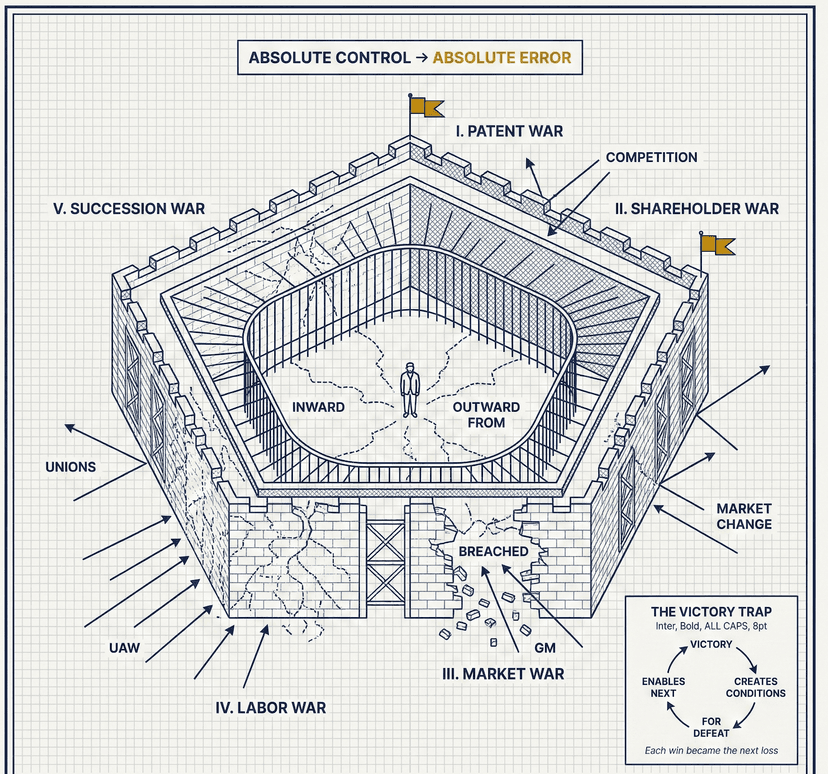
The Patent War
"In law, nothing is certain but the expense." — Samuel Butler
On May 8, 1879, a patent attorney in Rochester, New York, named George Baldwin Selden filed an application for what he called a "road engine." He was not an inventor in any meaningful sense. He was a lawyer who understood paperwork. Selden had attended the 1876 Centennial Exposition in Philadelphia and seen George Brayton's "Ready Motor" on display. He grasped, before almost anyone else in America, that the internal combustion engine would eventually replace the horse. His insight was genuine. What followed was not invention but procedure.
Selden never built a working automobile. What he built was a patent application, and he spent the next sixteen years filing continuation amendments to prevent it from issuing. This was legal at the time. Patent terms ran from the date of grant, not the date of filing, so an applicant who delayed issuance delayed the clock. Selden waited for a commercial automobile industry to emerge. When it did, in the mid-1890s, he allowed his patent to mature. It issued on November 5, 1895, as Patent No. 549,160, covering broadly a road vehicle powered by a liquid hydrocarbon engine. George Eastman of Kodak fame had witnessed the original filing. That was the most impressive credential attached to the patent. 4The device Selden described worked so poorly that when two prototypes were later constructed for the trial, neither could travel more than a few thousand yards under its own power. A man who never built a working automobile nearly controlled the entire American automobile industry. When the courts finally required him to demonstrate the device described in his patent, the thing staggered across the testing ground like a drunk leaving a bar at closing time, coughed, and quit. Selden's legacy is a reminder that you do not need a product to own a market. You need paperwork.
In 1899, Selden sold enforcement rights to the Electric Vehicle Company, which formed the Association of Licensed Automobile Manufacturers in 1903. ALAM demanded a 1.25 percent royalty on every gasoline automobile sold in America and claimed the authority to decide which companies could manufacture cars at all. A five-member executive committee, requiring unanimous approval, controlled entry to the industry. Frederic L. Smith, president of ALAM and former head of Olds Motor Works (the man who had forced Ransom Olds out of his own company for building cars too cheaply), sat on the committee. By 1903, most established manufacturers had taken licenses. Small brass plaques reading "Manufactured under Selden Patent" appeared on nearly every automobile rolling off American assembly lines. ALAM ran advertisements in newspapers warning consumers not to "buy a lawsuit with your new automobile."
Henry Ford applied for a license in June 1903, weeks after incorporating Ford Motor Company. ALAM rejected him. The stated reason: Ford was an assembler, not a manufacturer. The actual reason was less flattering. Several of Ford's former investors and business partners already held positions within ALAM's hierarchy. They had watched him fail twice before. They saw no reason to credential a third attempt.
On October 22, 1903, ALAM filed suit against Ford Motor Company for patent infringement. Ford was four months old as a corporation. The lawsuit could have ended everything. Dozens of other unlicensed manufacturers quietly took licenses rather than fight. Ford did the opposite. He published advertisements in major newspapers calling the Selden patent a fraud and the ALAM a trust. 1"We believe that the art would have been just as far advanced to-day if Mr. Selden had never been born," Ford's ad read. In the context of Theodore Roosevelt's America, where "trust" was the dirtiest word in the political vocabulary, Ford had weaponized public opinion before the first deposition was taken. The legal battle would last eight years. Ford's publicity battle was won in eight weeks.
There is a concept in game theory called the "war of attrition," formalized by John Maynard Smith in 1974 to explain animal conflicts. Two contestants compete for a resource. Each incurs costs as the contest continues. The winner is whoever is willing to pay the higher cost. The critical variable is not fighting ability but the contestants' beliefs about each other's willingness to persist. Ford understood this intuitively. He promised to indemnify every customer against any legal consequence of the Selden patent, pledging Ford Motor Company's full assets to back the guarantee. This transferred his customers' risk to himself, making it costless for buyers to choose Ford over a licensed competitor. Every Ford sold during the litigation became a vote of confidence in Ford's willingness to fight, and every customer became a stakeholder in Ford's legal victory.
Ralzemond A. Parker, Ford's lead attorney, developed the argument that decided the case. Selden's patent specified a Brayton-cycle engine, a two-stroke, constant-pressure design that George Brayton had patented in 1872 and marketed as the "Ready Motor." Ford and every other manufacturer used Otto-cycle engines, the four-stroke, constant-volume design invented by Nikolaus Otto in 1876, which operated on entirely different thermodynamic principles. The Brayton engine used continuous combustion with a separate compression and expansion cylinder. The Otto engine used intermittent combustion within a single cylinder. They were as different as a furnace and a firecracker. Selden's patent covered one. The automobile industry used the other.
Judge Charles Merrill Hough ruled against Ford on September 15, 1909, finding the Selden patent valid and infringed. Ford appealed immediately. The case rose to the United States Circuit Court of Appeals. On January 9, 1911, the appellate court reversed. The Selden patent was valid but only for vehicles using the Brayton-type engine, which no manufacturer had ever used. ALAM chose not to contest the ruling. The patent was due to expire the following year anyway. By the time the appeals court ruled, Ford Motor Company had grown from producing approximately 1,700 vehicles in its first full fiscal year to 69,762 annually. The Uruguay Round Agreements Act of 1994 finally closed the continuation loophole that Selden had exploited, measuring patent terms from filing date rather than grant date. It took Congress 115 years to close the door that one Rochester lawyer had walked through.
Consider what compliance bought the manufacturers who paid the Selden royalty. They followed the rules. They took their licenses. They affixed their brass plaques. And when ALAM dissolved in 1911, they had nothing to show for years of payments except a demonstrated willingness to submit. Studebaker, Hudson, Nash, Packard, Pierce-Arrow, Willys-Overland: by 1960, all gone or absorbed. The companies that paid the toll did not outlive the tollbooth. Compliance was not a survival strategy. It was a tax on timidity.
The Shareholder War
"The major incentive to the stockholder is not dividends, but growth." — Philip Fisher
On a Saturday afternoon in November 1902, John Dodge and Horace Dodge shook hands with Henry Ford at a wedding reception. Within months, the Dodge brothers' machine shop was producing every engine, transmission, and axle for Ford Motor Company. The Dodges invested $10,000 and received a 10 percent stake. John also served as a director and vice president. The arrangement worked beautifully as long as Ford Motor Company was small and the Dodges' manufacturing capacity was indispensable. It stopped working the moment Ford got big enough to build his own parts.
Ford Motor Company's financial performance between 1903 and 1916 belongs in a different category than most corporate success stories. The company paid $41 million in special dividends on initial capitalization of just $28,000 (the actual cash contributed by the original twelve investors). Regular dividends ran at five percent per month. James Couzens, the business manager who ran Ford's operations for the first decade, had invested $2,500. Horace Rackham, the lawyer who drew up the incorporation papers, put in $5,000. Rackham's banker had told him the investment was foolish. That banker spent the next several decades in Detroit, watching the most profitable company in American history grow from the investment he had advised his client to decline, attending the same dinner parties as the men whose wealth he had tried to prevent. There is no record of what he told people at those dinners. There is also no need to speculate.
By 1916, the Dodges wanted those profits distributed. They had founded Dodge Brothers, Inc. in 1914 and needed Ford dividends to fund their own automobile manufacturing. Ford wanted the profits reinvested. He was planning the River Rouge complex, the most ambitious vertical integration project in industrial history. The Dodges filed suit in November 1916, asking the Michigan courts to compel Ford Motor Company to distribute accumulated surplus as dividends.
Ford made the case easy for the Dodges. During his deposition, he stated his philosophy with the clarity of a man who had never seen a reason to disguise his intentions. 7The court recorded Ford's testimony that the company's purpose was to do as much good as possible for everybody concerned, to make cars ever cheaper, and to give employment to more men at higher wages. This was corporate heresy in 1916. It remains corporate heresy in boardrooms where fiduciary duty is discussed with religious solemnity.
Chief Justice Russell C. Ostrander of the Michigan Supreme Court wrote the opinion that has haunted corporate law for a century. The court ordered Ford to distribute $19.3 million in special dividends. Ostrander's reasoning became the textbook case for shareholder primacy: a corporation exists for the profit of its stockholders. Directors cannot openly subordinate shareholder returns to other purposes, however admirable. Legal scholars have debated the scope of this holding ever since. Lynn Stout argued in The Shareholder Value Myth that the conventional interpretation is too broad, that the case really stands for the narrower proposition that directors cannot openly repudiate their obligations to shareholders while pursuing alternative goals. 8The distinction matters. A founder who quietly reinvests profits while maintaining that shareholders are being well served faces different legal exposure than a founder who tells a courtroom, in essence, that shareholders can go hang. Ford did the latter.
Ford's response revealed something about power that no law school casebook adequately captures. He could not prevent the ordered dividend, but he could prevent future litigation by eliminating future plaintiffs. In March 1919, Ford announced he was forming a new company to build automobiles even cheaper than the Model T. Ford Motor Company could do whatever the minority shareholders wanted with their enterprise. He would simply compete against it.
The threat was credible. Ford at fifty-five had lost none of his competitive energy. A new Ford company would draw on his name, his dealers, his suppliers, his expertise. The existing Ford Motor Company would become a shell. Thomas Schelling, the game theorist who won the Nobel Prize in 2005 for his work on conflict and cooperation, called this "the power of commitment." The ability to constrain your own future options, when it is visible and credible, forces the other party to accommodate. Ford constrained himself brilliantly. By announcing a competing venture, he made "hold your shares" a losing proposition for every minority owner. They faced a binary choice: sell at Ford's price or hold shares in a company he was about to destroy.
Negotiations proceeded through intermediaries. Ford's agents, operating through a shell company called the Eastern Holding Company, contacted each minority shareholder individually. Shareholders who cannot coordinate are easier to buy out than shareholders who can. This is elementary game theory, and Ford practiced it before the discipline had a name. The Dodges sold for $25 million. Couzens sold for $30 million. Rackham and John Anderson, the lawyers, received $12.5 million each. The heirs of John Gray received $26.25 million. Even Rosetta Couzens Hauss, James Couzens' sister, received $262,500 for the single $100 bill she had invested in 1903. A 262,400 percent return. Venture capitalists who achieve one-tenth of that ratio write books about it.
Ford financed the $105,820,894 purchase by borrowing $75 million from a banking syndicate led by Chase Securities. A man who had built the world's largest manufacturing company on cash flow, who had never taken a mortgage on his home, walked into a bank and signed his name on a $75 million note. His distrust of banks, already substantial, calcified into something closer to doctrine after that signature dried. It cost his company access to capital markets during the Depression, when credit could have made the difference between retrenchment and collapse. The pen that bought him total freedom also wrote the terms of his next imprisonment.
By July 1919, Henry Ford, his wife Clara, and their son Edsel owned 100 percent of Ford Motor Company. Henry held 55.19 percent, Clara 3.14 percent, and Edsel 41.67 percent. The Dodges were gone. Couzens was gone. Ford Motor Company had become what Henry Ford always wanted: a personal instrument, answerable to no one.
Both Dodge brothers died within eleven months of receiving their buyout proceeds. John died of influenza in January 1920 at age fifty-five. Horace died of cirrhosis the following December at age fifty-two. Their automobile company, built with Ford dividends, survived until 1928, when Walter Chrysler purchased it to create the third member of Detroit's Big Three.
Total control enabled everything that followed. Without minority shareholders, no board could overrule Henry Ford. No investor could demand accountability. The River Rouge plant was built with money that might otherwise have gone to dividends. So was Fordlandia, the disastrous Brazilian rubber plantation that Ford carved out of the Amazon in 1928. Ford attempted to impose Dearborn, Michigan on the Brazilian jungle with the literalness of a man who had never questioned whether his preferences were universal truths. He banned alcohol in a country where it was woven into the social fabric. He mandated square dancing in equatorial heat. He insisted on hamburgers in a land where nobody ate beef. He built American-style bungalows with metal roofs that turned into ovens under the tropical sun, then wondered why workers preferred their own hammocks. The rubber trees, planted in neat Michigan rows instead of scattered through the jungle as nature intended, attracted leaf blight that wiped out entire groves. Even the trees refused to cooperate with Henry Ford's vision of order. Fordlandia cost an estimated $20 million, produced virtually no usable rubber, and stands today as a slowly decaying monument to the proposition that if you are the most successful manufacturer in the world, surely you can also run a rubber plantation in the Amazon. You cannot. The Amazon does not read your press clippings. The Dearborn Independent is its tragedy.
Starting in 1920, Ford used his personal newspaper to publish a seven-year campaign of anti-Semitic conspiracy theories under the running title "The International Jew." The articles blamed Jewish financiers for everything from the First World War to the degradation of American morals. Compiled into pamphlets, translated into German, Spanish, Portuguese, and Arabic, they circulated internationally. Adolf Hitler kept a portrait of Henry Ford in his Munich office. Ford is the only American mentioned by name in Mein Kampf. In 1938, Ford accepted the Grand Cross of the German Eagle from the Third Reich, the highest honor the Nazi government could bestow on a foreign citizen. Seven years of published hate by the most famous industrialist in America, and no one inside Ford Motor Company stopped it. No board voted. No shareholder objected. No executive intervened. The organizational structure that this volume documents across five wars, total control with no countervailing voices, had eliminated every mechanism that might have checked a single man's worst impulses. The Dearborn Independent is not a footnote. It is the Control Paradox's darkest exhibit.
The Dodge case taught a century of entrepreneurs that shared ownership means shared control. Mark Zuckerberg structured Facebook with dual-class shares, ensuring that public shareholders could never outvote him regardless of their economic stake. Larry Page and Sergey Brin did the same at Google. Travis Kalanick at Uber did not, and when his board decided he had to go in 2017, they had the governance mechanisms to force it. Kalanick's departure was messy, humiliating, and probably necessary. Ford's story shows what happens when those mechanisms do not exist. If you are a founder who has ever wished your board would simply go away, Ford's story is the cautionary tale you have been avoiding. He got his wish. The subsequent thirty years are the evidence.
The Market War
"It is not the strongest of the species that survives, nor the most intelligent, but the one most responsive to change." — often attributed to Charles Darwin, actually Leon C. Megginson, 1963
In a Hollywood custom-body shop in 1926, a designer named Harley Earl was building one-off automobiles for movie stars. His cars were low, long, sculpted, everything the Model T was not. Lawrence P. Fisher, head of Cadillac, invited Earl to Detroit to design a new companion car called the LaSalle. Earl arrived expecting a consulting job. He left having invented an industry.
By 1921, Ford Motor Company controlled approximately sixty percent of the American automobile market. Chevrolet held four percent. Within six years, the positions reversed. Ford's share collapsed to fifteen percent. GM claimed over forty percent. Ford never regained the lead. The most dominant market position in American industrial history, surrendered in half a decade, and not because of a single catastrophic error. Because of a structural incapacity to perceive that the world had changed.
Alfred Pritchard Sloan Jr. had trained as an electrical engineer at MIT and made his first fortune in roller bearings. He had no particular feeling for automobiles. What he understood was organization. General Motors in 1920 needed organizing badly. William Crapo Durant, the company's founder, had assembled GM through acquisitions so rapid that even he could not keep track of what he owned. Walter Chrysler said Durant "could coax a bird right down out of a tree." But Durant was also a gambler who believed expansion solved every problem. By 1920, GM comprised Buick, Cadillac, Oldsmobile, Oakland, Chevrolet, and dozens of parts suppliers, with no coordination between divisions and no coherent strategy for the whole. Pierre du Pont, installed as president after Durant's second expulsion, had no interest in running an automobile company. He appointed Sloan to do it for him.
Sloan's first insight was that GM's chaos was also its opportunity. Ford offered one product at one price point. GM could offer a ladder. 3"A car for every purse and purpose," Sloan called it. Chevrolet at the bottom for buyers stretching to afford their first automobile. Pontiac and Oldsmobile in the middle for the aspiring. Buick for the arrived. Cadillac for those who had no need to ask the price. Each division needed distinct positioning to avoid cannibalizing its siblings. Prices overlapped slightly, so that a successful Chevrolet buyer's next car would be a Pontiac, not a Ford. You could read your neighbor's ambitions off their driveway. Thorstein Veblen had described this mechanism with clinical precision in The Theory of the Leisure Class in 1899, twenty years before Sloan weaponized it: consumption as social signal, purchases as public declarations of status. Veblen coined "conspicuous consumption" as a term of sociological critique. Sloan converted it into an operating system. The entire GM strategy was Veblenian economics made operational, which means Sloan's competitive advantage was not a product insight but a sociological one. He understood something about human beings that Ford, for all his manufacturing genius, refused to see: people do not buy transportation. They buy a story about who they are becoming. Ford thought he was in the automobile business. Sloan understood he was in the aspiration business. That reframe, invisible to Ford because it violated his deepest convictions about thrift and utility, was worth more than any engineering advantage GM ever held.
Sloan imposed central financial controls while preserving divisional autonomy, a structure that business schools later named the multidivisional form, or M-form. The biological parallel is instructive. In ecology, a monoculture maximizes yield under stable conditions. A single wheat field produces more per acre than a diverse forest. But a wheat field is catastrophically vulnerable to any pest adapted to wheat. A forest survives because its diversity absorbs shocks that destroy any single species. Ecologists call this the "portfolio effect," the same principle that Harry Markowitz formalized in modern portfolio theory in 1952 when he proved that diversified investment portfolios outperform concentrated ones on a risk-adjusted basis. Ford's Model T was the wheat field. GM's multi-brand architecture was the forest. The market was about to introduce a new pest.
Sloan's second insight was that the automobile market had changed in kind, not degree. In 1908, when Ford introduced the Model T, most Americans had never owned a car. First-time buyers wanted basic transportation. Price was the dominant consideration. Reliability mattered. Style did not. By 1920, the market was saturating. Millions of Americans already owned automobiles, many of them Model Ts. These buyers did not want basic transportation; they already had it. They wanted the upgrade. They wanted the car that announced to their neighbors that they had prospered. Ford was selling first cars to a market increasingly composed of second-car buyers. The ground had shifted beneath his feet. And who was going to tell him?
Earl changed everything. In 1927, Sloan created the Art and Colour Section, the automobile industry's first in-house design studio, and installed Earl as its director. GM's engineers initially dismissed Earl's team as "pretty picture boys" working in "the beauty parlor." They stopped laughing when the styled cars outsold the engineered ones. Earl introduced clay modeling, which allowed rapid iteration on body shapes. He developed the annual model change, which created a reason for buyers to replace functional automobiles with newer ones. He designed the tailfin, inspired by the twin-boom fuselage of the Lockheed P-38 Lightning fighter, and watched it become the defining visual element of 1950s America. The first tailfins appeared on the 1948 Cadillac. By 1959, they had grown to proportions that even Earl considered absurd, peaking on the Cadillac Eldorado Biarritz, a chrome-encrusted monument to American postwar excess that looked as if a fighter jet had mated with a living room. At its peak, Earl's operation employed over 1,400 people and shaped the visual vocabulary of an entire era. By the time he retired in 1958, he had supervised the design of 35 million vehicles.
"The old master had failed to master change. He left behind a car that no longer offered the best buy, even as raw, basic transportation."
Alfred P. Sloan
Sloan and Earl called their strategy "Dynamic Obsolescence." Critics called it planned obsolescence. The principle was identical: make customers dissatisfied with what they owned. Ford built cars to last. GM built cars to be replaced. The question of which approach is more honorable is beside the point. The question of which approach won is not.
Here is the uncomfortable truth this volume must sit with rather than resolve. If you were advising Ford in 1919, you would not tell him to hold his convictions more loosely. His obsession with affordability was the competitive weapon that built the company. The $260 Model T existed because Ford refused to listen to people who told him the car needed to be fancier, more comfortable, better looking. Every piece of advice he ignored between 1908 and 1920 was advice that, had he followed it, would have produced a more expensive, less dominant automobile. His stubbornness was not a character flaw that happened to coexist with genius. It was the genius. And that is what makes the subsequent decade so difficult to learn from. The same instinct that produced the cheapest reliable car in history also prevented Ford from seeing that price was no longer the only axis that mattered. You cannot tell a founder to be stubborn selectively. Stubbornness does not come with a dial. It comes with an on/off switch, and Ford's was welded to the on position. The lesson is not "be more flexible." The lesson is that the quality most responsible for your greatest success is probably the quality most responsible for your next failure, and you will not be able to see the transition because the quality feels identical in both phases.
Financial innovation enabled GM's strategy as much as design did. In 1919, Sloan created the General Motors Acceptance Corporation, which allowed buyers to purchase automobiles on installment credit. Ford, who distrusted debt in all its forms, refused to offer financing until 1928. 1Ford believed that consumers should save until they could pay cash, that installment purchases trapped working families. He was not entirely wrong. Consumer debt, measured as a percentage of household income, has risen almost continuously since GMAC pioneered the model. But families wanted cars now, not after years of saving, and GM was happy to accommodate them. When one competitor offers financing and another does not, moral arguments do not change market conditions.
Ford's technological stubbornness compounded the strategic errors. The Model T used a planetary transmission that required drivers to coordinate three foot pedals and a hand lever simultaneously. Competitors had adopted the conventional sliding-gear transmission. Ford offered only mechanical brakes long after competitors switched to hydraulics. The styling had not changed meaningfully since 1908. By the mid-1920s, used cars from other manufacturers offered better value than a new Model T.
In January 1926, Ernest Kanzler, Ford's son-in-law and a senior executive, wrote an eight-page memorandum urging modernization. Market share losses, competitive features Ford lacked, evidence that continued stubbornness would cost the company its dominant position. A thorough, evidence-based diagnosis delivered by a family member who had earned the right to speak. Ford read it and fired Kanzler. That firing accomplished two things: it removed the diagnosis, and it taught every other executive in the company what happened to people who delivered unwelcome truths. After Kanzler, nobody told Ford the Model T was dying. Not because they did not know, but because they had seen the cost of knowing out loud. Claude Shannon formalized this dynamic in 1948 when he published "A Mathematical Theory of Communication." Shannon proved that every communication channel has a capacity limit determined by the ratio of signal power to noise power. When noise exceeds signal, the channel capacity drops to zero regardless of how loudly the sender transmits. Ford's organization did not merely degrade information passively, the way a long telephone wire loses clarity. It actively generated noise. Bennett filed contradictory reports. Sycophants produced flattering distortions. The punishment of accurate messengers taught the entire system to replace signal with static. Shannon's mathematics describe what happens next: when noise generation exceeds signal strength, no amount of volume, no boldness of memo, no clarity of data can push information through. The channel is dead. Kanzler was not whispering into a long hallway. He was shouting into a hurricane that Ford's own management had built. The eight pages were flawless. The channel capacity for unwelcome truth had been engineered, systematically and irreversibly, to zero.
May 1927. Ford Motor Company shut down for six months to retool for a new model. Sixty thousand workers were laid off. Highland Park fell silent. The largest automaker in the world produced not a single automobile. Fifteen million Model Ts had been built. No more followed. Ford announced the Model A with features that Edsel had advocated for years: hydraulic brakes, sliding-gear transmission, multiple body styles, multiple colors.
Ten million Americans visited Ford dealerships within 36 hours of the Model A's unveiling. 1.25 million people saw it at Madison Square Garden in five days. Within six months, Ford had sold two million units. But the Model A was a catch-up, not a leap. Ford had spent six months, $250 million, and the livelihoods of sixty thousand families to achieve parity with a competitor that had overtaken it two years earlier.
Durant, the man Sloan replaced at GM, ended his career running a bowling alley in Flint, Michigan. He had built two automobile empires and lost them both. In his final years, he survived on a pension quietly arranged by Sloan, supplemented by handouts from the Chrysler family. A man who saw the future of the automobile industry more clearly than anyone alive, but who could not build an organization that survived his own presence. He died in 1947, the same year as Henry Ford, in circumstances that could not have been more different. Ford left an estate worth hundreds of millions. Durant left debts. Vision without execution is expensive, and the bill comes due in bowling alleys.
Ford's failure was of a different order. He had built the organization. He had dominated the market. He had the resources to respond. What he lacked was the capacity to see that the world had changed, because he had spent two decades constructing a company that could only confirm what he already believed. Physicists would recognize what Ford had built: a closed thermodynamic system. The second law of thermodynamics states that a closed system, one that exchanges no energy or matter with its environment, tends irreversibly toward maximum entropy, toward disorder, toward heat death. This is not a metaphor. It is a mathematical certainty. Ford's organization had sealed itself off from external information with the same finality that an insulated container seals off heat exchange. It could process internal information with extraordinary efficiency, recycling the same data, the same assumptions, the same conclusions with mechanical precision. What it could not do was absorb new information from outside. Every executive who might have carried market intelligence inward had been taught, by Kanzler's firing, that the cost of transmission exceeded the value of the message. The system was thermodynamically closed. Entropy was increasing. Ford offered 1920s America archaeology. America wanted progress.
The Labor War
"Power tends to corrupt, and absolute power corrupts absolutely." — Lord Acton, letter to Bishop Mandell Creighton, 1887
The man who became Henry Ford's enforcer stood five feet six inches tall and weighed 145 pounds. Harry Herbert Bennett had served in the Navy, boxed professionally, and cultivated connections with Detroit's criminal underworld. Ford hired him in 1916 or 1917 as a watchman. By 1921, Bennett commanded the Service Department, Ford Motor Company's internal security force. By 1943, he was the second most powerful man in the company, answering only to Henry Ford himself. He kept a pistol in his desk drawer. He kept a pair of live tigers in the yard of his Ann Arbor estate, which he purchased from a circus and maintained, apparently, because he enjoyed the effect they produced on visitors. A five-foot-six former boxer with underworld connections, a loaded weapon within arm's reach, and actual Bengal tigers in the garden. The second most powerful man at Ford Motor Company was, by any objective assessment, insane. Henry Ford considered him indispensable.
Bennett's rise reflected Ford's evolving relationship with his own workforce. The man who had doubled wages in 1914 to reduce turnover had become, by the 1930s, someone who viewed his workers with suspicion and his critics with contempt. The Five Dollar Day had been paternalism at its most generous. The assembly line had reduced the time to build a Model T from twelve and a half hours to ninety-three minutes, but the work had become so monotonous that turnover at Highland Park reached 370 percent annually. Ford's profits hit $13 million in 1912, $27 million in 1913, $32 million in 1914. A one-week shutdown, economists estimated, would cost Ford at least $542,000 in lost earnings, compared to $184,000 for the more diversified General Motors. Ford's vulnerability was concentrated in a single factory and a single product. The Five Dollar Day was brilliant labor economics disguised as philanthropy.
The wage increase came attached to a surveillance apparatus. Ford's Sociological Department, established in 1914, sent fifty investigators racing around Detroit in Ford automobiles, making unannounced visits to workers' homes to evaluate cleanliness, sobriety, family stability, and savings habits. Workers who failed inspection lost the profit-sharing portion of their wages. Seventy percent of Ford's workforce were foreign-born, and the investigators were particularly interested in "Americanizing" immigrants from eastern and southern Europe: English classes were mandatory, citizenship courses expected. Dean Samuel Marquis, an Episcopalian minister, ran the department with genuine concern for workers' welfare. But the fundamental architecture was disciplinary. You earned $5 only if the company approved of how you lived. Ford had created, perhaps without realizing it, a prototype of the corporate panopticon that Michel Foucault would later describe in Discipline and Punish: a system where the possibility of being observed at any time produces self-regulation more effectively than constant direct supervision.
If you were advising a manufacturer in 1914 whose workforce turned over completely three and a half times each year, you would tell him to raise wages. Ford's generosity was the right move. And this is where the volume's own argument needs to confront itself. The conventional reading is that Ford started generous and became cruel, that something corrupted him, that the Five Dollar Day and the Service Department represent different chapters of a man's moral decline. That reading is comforting and wrong. The Five Dollar Day and the Service Department were the same chapter. Both emerged from an identical conviction: Henry Ford knew what his workers needed better than they did. When he was right about what they needed, this produced the highest industrial wages in America. When he was wrong, it produced Harry Bennett. The difference between a doubled paycheck and a beating on a pedestrian bridge was not a change in character. It was the same character applied to a situation where the workers had stopped agreeing with Ford's definition of their needs. Paternalism does not corrupt gradually. It works, and the working is what makes it dangerous, because success teaches the paternalist that his judgment is reliable in every domain, with every population, forever. The distance between generosity and violence is not a slippery slope. It is a straight line drawn by a man who never doubted he was walking it for your own good.
The Service Department was paternalism stripped of its generosity, retaining only the control. Both assumed workers needed guidance. The difference was whether guidance arrived through wages or through fear. On the department's official ledger: plant security. In practice: surveillance, intimidation, and the suppression of labor organizing. Bennett recruited from the ranks of ex-convicts, former athletes, and men comfortable with violence. At its peak, the department employed approximately 3,000 people, a private army operating within an industrial enterprise. The Roman Republic collapsed, in part, when private armies loyal to individual generals replaced the citizen militia loyal to the state. Ford Motor Company's Service Department was a private army loyal to one man, operating inside an institution that theoretically answered to a broader constituency. The architecture was identical. The trajectory was predictable.
First blood came on March 7, 1932, during what became known as the Ford Hunger March. The Communist Party had organized a demonstration of unemployed workers to march from Detroit to the River Rouge plant in Dearborn. Approximately 3,000 people participated. As the marchers approached the plant gate, Dearborn police and Ford security opened fire. Five men died. Dozens more were wounded. The dead were buried beneath a monument inscribed with a quotation from Lenin.
Five years later, the National Labor Relations Act had guaranteed workers the right to organize. General Motors recognized the United Automobile Workers in February 1937, following the sit-down strikes in Flint. Chrysler followed in April. Ford, alone among the major automakers, refused.
"We'll never recognize the UAW, or any other union. Labor Unions are the worst thing that ever struck the earth."
Henry Ford, 1937
On May 26, 1937, UAW organizers Walter Reuther and Richard Frankensteen arrived at the Miller Road overpass outside the Rouge plant to distribute leaflets. They had notified the press. They expected confrontation and planned to document it. What they did not expect was the savagery of Bennett's response.
As Reuther and Frankensteen posed for photographs on the overpass, approximately forty men in civilian clothes surrounded them. Frankensteen's coat was pulled over his head to blind him while men kicked him in the kidneys. Reuther was thrown down a flight of metal stairs. Sixteen people were injured, including women who had been distributing leaflets. Bennett's men made one critical error. They failed to confiscate all the cameras. James Kilpatrick of the Detroit News escaped with his film. The photographs ran in newspapers across the country, showing well-dressed thugs beating unarmed men on a pedestrian bridge. The Battle of the Overpass transformed Ford from employer into villain in the public imagination. The same man who had been a folk hero for fighting the Selden trust was now photographed presiding over a private militia.
Ford's public response was denial. The company claimed the union organizers had attacked first. Bennett told reporters he had no idea who the attackers were. The National Labor Relations Board found Ford guilty of unfair labor practices on December 22, 1937, and ordered the company to cease interfering with union organizing. Ford ignored the order. For four more years, the company continued to fire union sympathizers, maintain surveillance on workers, and deploy Bennett's men against organizers.
In April 1941, Ford fired eight union members at the Rouge plant. The UAW called a strike. Within hours, 50,000 workers walked out. Ford was prepared to shut down the company rather than submit. Charles Sorensen, his production chief, later recalled that Ford "was very close to following through with a threat to break up the company rather than cooperate." 5Ford had beaten the Selden patent. He had beaten the minority shareholders. He would beat the union.
Clara Ford changed his mind. His wife of fifty-three years had supported every venture, tolerated every eccentricity, rarely interfered in company business. Now she told Henry that if he destroyed the family business, she would leave him. Remember this moment. Clara Ford will appear again.
On June 20, 1941, Ford Motor Company signed a contract with the UAW more generous than either GM's or Chrysler's. Union shop, automatic dues deduction, reinstatement of fired workers with back pay. The most stubborn holdout had become the most accommodating signatory.
Ford later told Walter Reuther: "It was one of the most sensible things Harry Bennett ever did when he got the UAW into this plant. Well, you've been fighting General Motors and the Wall Street crowd. Now you're in here and we've given you a union shop and more than you got out of them. That puts you on our side, doesn't it? We can fight General Motors and Wall Street together." Ford had not changed his views about unions, workers, or his own righteousness. He had incorporated the union into his existing framework of enemies and allies. He could not admit error. He could only redefine victory.
1"A great business is really too big to be human," Ford had written in 1922. He meant it as justification for systems that removed discretion from workers. He did not mean it as self-indictment. But the sentence describes his own company more accurately than he knew. Bennett's Service Department was the logical terminus of that philosophy: a system so thoroughly inhuman that it could beat a man half to death without anyone in particular deciding to do so. The Five Dollar Day and the Battle of the Overpass were the same conviction applied with different instruments. Ford believed he knew what was best for his workers. Whether the imposition arrived as a wage increase or a fist depended on circumstances, not intent. If you manage people and have ever said "I only want what's best for my team," pause on that sentence. Hold it in your mouth. Now ask yourself: has there ever been a moment when someone on your team disagreed with your definition of their best interest, and you experienced that disagreement as ingratitude? If the answer is yes, you are on Ford's road. You may be at mile one. You may be at mile forty. The road does not tell you where you are. It only tells you the direction. The distance between "I only want what's best for my team" and a private militia is shorter than you think, and every step between them felt, to the man taking it, like common sense.
The Succession War
"There is no greater agony than bearing an untold story inside you." — Maya Angelou
In the late 1930s, Edsel Ford, who had served as president of Ford Motor Company for two decades, developed a prototype modern sedan. It had hydraulic brakes. It had a conventional sliding-gear transmission. It had the features that every competitor already offered, the features that customers were buying Chevrolets to get. Henry Ford reportedly took a sledgehammer to it. A man in his seventies smashing his son's work with a heavy tool, destroying in seconds what had taken months to build. This was not an argument about engineering. It was a verdict about power, delivered in a language older than speech.
Edsel Bryant Ford had become president on December 31, 1918, at the age of twenty-five. He held the title for twenty-four years, until his death on May 26, 1943. In all that time, he was never permitted to exercise the authority the title implied. His father promoted him and systematically undermined him. The daily humiliations, the public reversals, the cultivation of rivals who held Edsel in open contempt: these were made crueler by the fact that they were inflicted by a father who, in his own way, loved his son. The psychology has a clinical name. Psychoanalysts since Alice Miller's The Drama of the Gifted Child have documented the particular damage inflicted by parents who cannot tolerate their children's autonomy. The narcissistic parent does not hate the child. The narcissistic parent cannot distinguish the child from an extension of the self, and any assertion of independent judgment registers as betrayal. Ford did not punish Edsel for being incompetent. He punished Edsel for being different.
Edsel was everything his father was not. Educated at private schools. Comfortable among Detroit's elite. He collected art, patronized the Detroit Institute of Arts, and built a home designed by Albert Kahn in Grosse Pointe Shores that remains one of the finest examples of Cotswold architecture in America. He dressed well, spoke softly, avoided confrontation. Henry, who dressed plainly and thrived on conflict, interpreted refinement as weakness.
"He killed my husband. He will not kill my son."
Eleanor Clay Ford, on Harry Bennett, 1945
Professional humiliations were unceasing. Edsel made a decision; Henry reversed it. Edsel hired an executive; Henry fired him. Edsel approved a design; Henry ordered it destroyed. Ford executives learned to check with the elder Ford before implementing anything the younger Ford had ordered. Edsel's authority existed on paper. Henry's authority existed in fact.
Harry Bennett became the instrument of Edsel's degradation. Bennett reported nominally to Edsel but actually to Henry, and he made no secret of his contempt for the president he ostensibly served. When Edsel attempted to discipline Bennett's men, Bennett went to Henry, and Henry supported Bennett. The message was unmistakable.
Yet Edsel's accomplishments, achieved despite constant interference, were substantial. He created the Mercury division to fill the gap between Ford and Lincoln in GM's market segmentation. He supervised the Lincoln-Zephyr. He personally oversaw the creation of the Lincoln Continental, working with designer E.T. "Bob" Gregorie on a car that now sits in the permanent collection of the Museum of Modern Art. Frank Lloyd Wright called it "the most beautiful car in the world." In 1938, Edsel asked Gregorie to design a personal car for his Florida vacation, something distinctive and European in character. Gregorie produced a long, low convertible with clean lines. Only 5,324 were ever built. Each was essentially handmade. The Continental is a monument to what a man can accomplish when his father's attention is directed elsewhere.
Edsel championed the Model A's development when his father finally accepted that the Model T had to be replaced. He pushed for hydraulic brakes, which Ford finally adopted in 1939, more than a decade after competitors. He advocated for the conventional transmission that replaced the Model T's planetary gearbox. In nearly every case, Edsel was right. In nearly every case, he waited years for his father to accept what was obvious to the rest of the industry.
The stress of this position killed him. Stomach ulcers developed into stomach cancer. Surgery in January 1942, but he continued working because the title was all he had and he was not going to relinquish it to Bennett. By early 1943, the cancer had spread. He grew thin. He still came to the office. He still signed papers that his father would reverse. He still sat in meetings where men who reported to him looked past him to the old man's wishes. Twenty-four years of this. Twenty-four years of having his name on a door and someone else's hand on the knob.
Edsel Bryant Ford died on May 26, 1943, at forty-nine years old. He weighed less than 130 pounds. His wife sat beside him. His sons, Henry II and Benson and William Clay, were scattered across military service and could not all reach Grosse Pointe Shores in time. The Continental he had asked Gregorie to design sat in the garage. The Mercury division he had created was selling well. The hydraulic brakes he had championed for a decade were standard equipment on every Ford rolling off the line. He was right about all of it. He had been right about all of it for years. And he died at forty-nine in a bedroom overlooking Lake St. Clair, having spent a quarter century proving that being right, in a company where one man's wrongness is structural, is a form of slow suffocation.
Henry blamed the death on drinking, on an inability to handle pressure. He did not mention the overruled decisions, the fired allies, the prototypes destroyed with a sledgehammer, or the twenty-four years of titles without authority. He did not mention Bennett. He delivered the eulogy anyway.
The war years that followed Edsel's death brought Ford Motor Company close to collapse. Henry was nominally in charge but increasingly incapable of decisions. Bennett filled the vacuum. Sorensen, who had been with Ford since 1905, was forced out in 1944 after Henry grew jealous of press coverage praising Sorensen's war production. Losses reached approximately $10 million per month by early 1945. The federal government, which depended on Ford for war production, considered nationalization.
Two women saved it.
Eleanor Clay Ford held more than forty percent of the company's stock, inherited from her husband. She had watched Bennett destroy Edsel. She would not allow him to destroy her sons. In the summer of 1945, Eleanor and Clara Ford confronted Henry with an ultimatum: install Henry Ford II as president, or Eleanor would sell her shares to outside investors, ending family control.
Clara Ford, who had changed Henry's mind about the union in 1941, changed his mind about succession in 1945. She was eighty years old. She had married him when he was a farmer's son tinkering with engines in a shed behind the house. She had fed him dinner while he built his first quadricycle in the kitchen workshop. She had watched him become the most famous industrialist in the world, and she had watched that fame curdle into something she barely recognized. Fifty-three years. She knew every version of the man: the tinkerer, the visionary, the empire builder, the anti-Semite, the father who broke his own son. Now she told the last version, the diminished old man losing hold of his faculties and his company, that he would install their grandson or she would leave. Not leave the company. Leave the marriage. She would walk out of Fair Lane and not come back. Whether she meant it or not is beside the point. He believed she meant it. That was enough.
In a volume about a man who won every fight except the ones that mattered most, Clara Ford is the figure who deserves the most attention and has received the least. Twice she intervened at the moment of maximum danger. Twice her intervention saved the enterprise. She operated without title, without formal authority, without any power except the willingness to issue an ultimatum she was prepared to carry out. Every governance structure in the world is, at its foundation, a promise backed by a credible threat. Clara Ford was the governance structure of last resort for the most powerful manufacturing enterprise on earth.
On September 20, 1945, Henry summoned his grandson to Fair Lane and informed him. The next day, Henry Ford II, twenty-eight years old, became president of Ford Motor Company. His first act was to fire Harry Bennett. Bennett claimed to have a document, signed by Henry Ford, naming him as decision-maker for the family's voting shares. The document was never produced. Bennett cleared out his office and left the Rouge plant for the last time. Within weeks, his allies were dismissed. The Service Department was disbanded.
The cruelest irony of Edsel's story arrived fifteen years after his death. In 1957, Ford Motor Company launched a new car division positioned between Ford and Mercury, exactly as Edsel had long advocated. The company named it the Edsel, over Henry Ford II's objections. The car was launched during a recession, plagued by quality problems, burdened with styling that consumers found bizarre. Production ceased in 1960 after approximately 118,000 units and losses of roughly $350 million. The name that should have honored Edsel Ford instead became a synonym for failure. The company gave him a memorial, and the memorial flopped. The lesson is darker than it appears. What destroyed the Edsel was not bad engineering or unlucky timing alone. The Whiz Kids' quantitative methods, the same tools that had saved Ford in 1946, had generated demand projections that overemphasized survey responses and underweighted the approaching recession. The toolkit that rescued the company produced, a decade later, its most famous disaster. Even dead, Edsel could not escape his father's shadow. And even reformed, Ford Motor Company could not escape the tendency of successful methods to calcify into orthodoxy.
The War Within
"The first step toward change is awareness. The second step is acceptance." — Nathaniel Branden
On April 7, 1947, the Rouge River flooded its banks and cut electrical power to Fair Lane, the estate Henry Ford had built forty years earlier. That night, by the light of kerosene lamps and candles, Henry Ford died of a cerebral hemorrhage at the age of eighty-three. He had been born by candlelight in a farmhouse in Dearborn in 1863. He died by candlelight in a mansion in Dearborn in 1947. Between those two rooms, lit by the same ancient technology, he had done more than any single person to make candlelight obsolete. The electricity was out. The river was up. The most consequential industrialist of the twentieth century left the world the same way he entered it: in the dark, with someone holding a flame.
Ford Motor Company was a shambles. 2Losses totaled $60 million in the first eight months of 1946 alone. Accounting systems were so primitive that no one could say precisely how much money was being lost or where. Ernest Breech, recruited from General Motors, described the company's financial systems as resembling "a country grocery store." 6Manufacturing facilities that had been the most advanced in the world in 1920 were decades behind competitors. Bennett's purges and the founder's paranoia had gutted the management ranks.
Henry Ford II, known within the company as "the Deuce," had been released from Navy service in July 1943 to help manage the company during his father Edsel's final illness. He had received virtually no preparation for leadership. His response demonstrated a quality his grandfather never possessed: the willingness to admit what he did not know.
"I am green and searching for answers. This company needs professional management, and it doesn't have any."
Henry Ford II, 1946
Ford II's first critical decision was to seek help from the competitor that had beaten his company. He hired Ernest R. Breech from General Motors subsidiary Bendix Aviation. Breech brought GM methods: decentralization, professional management, financial controls. Hiring your enemy's lieutenants requires a specific kind of humility, the admission that your enemy's methods are superior to your own. Institutional pride is a luxury that dying companies cannot afford. Ford II possessed the inverse of his grandfather's certainty. He knew he needed what he did not have. In ecology, this is called "adaptive radiation": a species that enters a new environment and rapidly diversifies to fill available niches. Ford II's willingness to import alien methods, GM executives, Army Air Forces statisticians, whatever worked, was adaptive radiation applied to corporate management. His grandfather had been the apex predator of a single habitat. The grandson was building a new one.
His second critical decision arrived unsolicited, in the form of a telegram. On October 19, 1945, a thirty-two-year-old Army Air Forces colonel named Charles "Tex" Thornton sent an extraordinary message: "Dear Mr. Ford. I represent a group of associates who have served under me at the office of statistical control, Army Air Force. We would like to discuss with you personally a matter of management importance and request an early meeting." Thornton proposed that Ford hire his entire team of ten statistical control officers as a package. All or nothing. The officers had spent the war applying quantitative analysis to military logistics, tracking everything from bomber efficiency to supply chain optimization. They averaged twenty-nine years old. None had any experience in automobile manufacturing. Thornton considered that an advantage.
Ten officers, most under thirty, none knowing a carburetor from a crankshaft, asking one of America's most famous industrial dynasties to hire them sight unseen, as a unit, at premium salaries. Ford II met with Thornton and was impressed. At the end of the meeting, before the young officers had even left the room, Ford said: "I want to hire all of you. Just put your name down and how much money you want." Salaries ranged from $8,000 to $15,000 annually, far above industry norms for their age and experience. A desperate twenty-eight-year-old buying rescue from ten confident twenty-nine-year-olds. But the value Ford was purchasing was not ten individual talents. It was ten people who had already learned to work together under pressure. Their shared methods, shared vocabulary, and shared trust meant they could begin producing results immediately rather than spending months building working relationships. In a crisis where months matter, that distinction separates survival from collapse.
Older Ford executives resented the ten officers before they unpacked their clipboards. They called them the Whiz Kids, initially as derision. The group wandered through plants asking questions that exposed the depth of the company's dysfunction. What does this operation cost? How do you know? Where are the records? After forty years of operation, Ford Motor Company could not answer. The man who had built the assembly line, who had reduced the time to manufacture a car from twelve hours to ninety-three minutes, had run a company that kept its books on the back of an envelope. The Whiz Kids were not performing an audit. They were building the capacity to perform one.
Robert S. McNamara eventually became Ford's president, the first person outside the Ford family to hold that title since 1919. He held the position for five weeks before accepting appointment as Secretary of Defense. Arjay Miller also became Ford's president and later dean of Stanford's Graduate School of Business. J. Edward Lundy served as chief financial officer until 1979. Seven of the ten reached senior management positions. Thornton himself lasted only two years, his personality clashing with Breech and the other GM imports. He departed for Hughes Aircraft and later built Litton Industries into one of the first modern conglomerates. Jack Reith turned around Ford of France, then was assigned to head the doomed Edsel division. The failure devastated him. He took his own life. Ten brilliant young men walked into a dying company with clipboards and confidence. One of them did not walk out.
Their most visible achievement was the 1949 Ford, the car that saved the company. Developed in nineteen months, a timeline the industry considered impossible, it abandoned prewar styling entirely and signaled a break with the past. On introduction day, 100,000 orders were placed. By year's end, Ford had sold over a million units. Competent, not revolutionary. But turnarounds die in the gap between internal reform and external proof. Financial controls and organizational charts do not inspire confidence. A product that customers line up to buy does.
Less visible than the 1949 Ford, but more consequential, was the reconstruction of Ford's management systems. Everything the Whiz Kids built served a single function: making invisible things visible. Internal audits, the first in the company's history, exposed costs that had accumulated unexamined for decades. Divisional cost tracking revealed which products earned money and which consumed it. By the time the reorganization was complete, approximately fifteen profit centers operated with enough autonomy to succeed or fail on their own terms, each visible to a headquarters that could finally see what it owned.
McNamara's trajectory revealed both the power and the limits of quantitative thinking. His wartime analysis had shown that approximately twenty percent of Eighth Air Force bombing missions were aborted, largely due to crew fear rather than mechanical failure. He devised scheduling systems that doubled the efficiency of B-29 transports. At Ford, he rose rapidly: controller by 1948, vice president and general manager by 1955, president by November 1960. He held the title for five weeks before Kennedy named him Secretary of Defense. He took the Whiz Kids' methods to the Pentagon and applied them to a war that did not yield to spreadsheets. Body counts, sortie rates, and hamlet evaluations measured everything except what mattered: whether the South Vietnamese population would fight for its own government. Vietnam was the Whiz Kids' methodology pushed past its domain of validity, a reminder that measurement is only as useful as your understanding of what to measure.
Miller reflected on the legacy in 1984: "It's in a failing or difficult situation where talent can express itself. Stars are born in turnarounds and startups." The observation contains an unintended warning. The conditions that produce stars also produce orthodoxies. The quantitative methods were perfectly suited to a company with no data in 1946. Any measurement was better than none. As Ford stabilized, those methods began to produce distortions. Costs that could be measured received attention. Quality that was harder to quantify did not. Short-term financial metrics dominated long-term product development. The Whiz Kids saved Ford from its founder's chaos and bequeathed it a different kind of rigidity, just expressed in spreadsheets rather than sledgehammers. The Japanese manufacturers that eventually challenged Detroit's dominance operated on premises the Whiz Kids' clipboards could not capture: that worker morale is a production input, that quality cannot be inspected in after the fact, that a car is a relationship with a customer, not a unit of revenue.
Ford Motor Company became a publicly traded corporation on January 17, 1956, ending fifty-three years of family ownership. The initial public offering was the largest in American history to that point. The Ford Foundation, which Henry Ford had created primarily for tax reasons, sold shares to the public while the Ford family retained voting control through a dual-class structure. Henry Ford had been dead for nine years. His distrust of Wall Street was alive and operational, embedded in governance architecture that kept outside shareholders at arm's length. The dead, it turns out, make excellent corporate strategists. They never change their minds.
Henry Ford II led the company until 1979, thirty-four years spanning the postwar boom, the rise of imports, the oil crises, and the beginning of Detroit's long decline. He was a more capable executive than his father had been allowed to become. He was also a Ford. He fired Lee Iacocca in 1978 with the explanation: "I just don't like you." Iacocca went to Chrysler and saved it. Three generations of Fords, and the reflexive purge remained in the DNA.
Candles lit the patriarch's deathbed in 1947, and their shadows reached forward across decades. Ford Motor Company survived because it was too valuable to fail and because, in the end, the Ford women chose continuity over pride. The Whiz Kids and their methods, the public offering and its capital, the professional managers and their disciplines: all represented repudiations of the founder's philosophy. Henry Ford built something that could survive him. He did not build something that could remain as he had made it. No founder does. Either you know that in time, or your organization has to learn it at your expense.
The Founder's Armory
"Plans are worthless, but planning is everything." — Dwight D. Eisenhower
Every war Ford fought left behind a weapon that others can use. But first, a note on the advice you have already encountered. Settle when the math favors it. Align your shareholders. Stay close to the customer. Treat your people well. Plan your succession early. Every coaching program covers it. Every leadership book includes it. This advice is rational, sensible, and aimed at the wrong level of the problem. It addresses individual decisions when the failures documented in this volume are structural. Ford did not lose the market war because he made a bad decision about the Model T. He lost it because the organizational structure he had built, total control with no dissent and no independent information channels, made it impossible for him to receive the information that would have changed his mind. The eight weapons that follow are divided into five field manuals (strategic frameworks derived from Ford's wars) and three portable playbooks (implementation protocols derived from the people who broke through Ford's failures). They are named after the operators and cases that created them. Abstraction is the enemy of application.
Field Manual I: The Exhaustion Doctrine
Derived from Ford v. ALAM (1903-1911). For founders facing legal or institutional threats where the standard advice is to calculate expected value and settle.
Standard advice treats litigation as an isolated event with calculable costs and probabilities. Ford's experience with the Selden patent reveals why that framing misses the strategic dimension entirely. Selden did not just want Ford's royalties; he wanted Ford's precedent. A settlement at 1.25 percent of list price would have been cheap in isolation. But the settlement would have created a permanent tax on the automobile industry, administered by a five-member board with veto power over new entrants. Ford's decision to fight was irrational measured against the Selden case alone. It was rational measured against every future encounter with institutional gatekeepers, because every settlement is a signal to every future adversary about your willingness to fight. Before you assess the merits of any individual dispute, ask what you are buying with the fight itself, what precedent the resistance establishes, and what capitulation invites.
Ford's second move was even more instructive than the decision to fight. He promised to defend every customer against any legal consequence of the Selden patent, pledging the company's full assets as backing. This transferred his customers' risk to himself, making it costless for buyers to choose Ford over a licensed competitor. The customers who bought Fords during the litigation became an army of stakeholders invested in Ford's legal victory. Their loyalty was purchased, at scale, through strategic risk absorption. Meanwhile, between 1903 and 1911, Ford's production grew from approximately 1,700 vehicles to 69,762 annually. Each year of litigation was a year in which Ford's business became harder to shut down and the plaintiff's position weakened. The operational test for whether exhaustion applies to your situation has three conditions, and all three must be true simultaneously. First: can your business grow during the fight? Ford could sell cars while the case proceeded. If your adversary can obtain injunctive relief that stops your operations, exhaustion is suicide, not strategy. Second: does time degrade the adversary's position faster than it degrades yours? Selden's patent had an expiration date. ALAM's member companies were already licensing Ford's customers away. Every month strengthened Ford and weakened ALAM. If your adversary's position improves with time (a regulator building a stronger case, a competitor gaining market share during your distraction), exhaustion destroys you. Third: can you convert the cost of fighting into a competitive advantage? Ford's customer indemnification turned a legal expense into a marketing program. If the fight is pure cost with no secondary benefit, settle. If all three conditions hold, fight. If any one fails, calculate the settlement.
Field Manual II: The Buyout Paradox
Derived from Dodge v. Ford (1916-1919). For founders whose governance conflicts cannot be resolved through alignment because the disagreements are about purpose, not facts.
Governance literature says alignment is the goal: get your shareholders on the same page. Ford and the Dodges could not be aligned because their disagreement was not about facts but about purposes. The Dodges wanted dividends. Ford wanted reinvestment. Both positions were rational given different objectives. No amount of communication could bridge that gap because both sides understood each other perfectly and still disagreed. Ford's solution was elimination. He announced he would start a competing company, a threat that worked because it was credible: Ford's name, his dealers, his suppliers, and his expertise would have made the existing company a shell. Ford's agents then contacted each minority shareholder individually, through the Eastern Holding Company. Shareholders who cannot coordinate are easier to buy out than shareholders who can.
The paradox is not the buyout. The paradox is what happens after. The operational question for any founder contemplating a buyout: write down, before you close the transaction, three specific decisions you will make differently once the dissenting voices are gone. If you cannot name three, you are not buying freedom to execute a strategy. You are buying silence. Ford could have named his: build River Rouge, standardize on a single model, reinvest all profits. Those were real strategic decisions that minority shareholders were blocking. But he could also have named decisions that the minority shareholders were right to resist, if he had been honest enough to look. Couzens had been the operational discipline Ford lacked. The Dodges had been the voice demanding financial accountability. Rackham had been the legal conscience. When Ford eliminated them all, he also eliminated the mechanisms that had, without anyone naming them as such, constrained his worst instincts. The implementation protocol: before any buyout or governance restructuring that removes dissenting voices, require yourself to identify not just the decisions you will make differently (the upside case) but the decisions you will now be able to make that no one will be positioned to challenge (the risk case). List them. Look at them. The second list is the one that matters. Fordlandia was on the second list. The Dearborn Independent was on the second list. If you cannot distinguish between the two lists, or if you find yourself convinced that the second list is empty, the buyout has already begun to compromise your judgment, and you have not yet signed the papers.
Field Manual III: The Kanzler Alarm
Derived from Ford's loss of market leadership to GM (1921-1927). For founders whose organizations cannot deliver bad news upward because the founder has demonstrated what happens to messengers.
In January 1926, Ernest Kanzler wrote an eight-page memorandum diagnosing the Model T's decline. Market share losses, competitive features Ford lacked, evidence that continued stubbornness would cost the company its dominant position. Thorough, evidence-based, delivered by a family member who had earned the right to speak. Ford read it and fired Kanzler. That firing destroyed more than one career. It taught every other person in the company what happened to people who delivered unwelcome truths. After Kanzler, no one told Ford the Model T was dying. Not because they did not know, but because they had seen the cost of knowing out loud.
This is the structural problem that no amount of individual courage can solve. Every founder claims to welcome feedback. The real test is not whether you welcome it but whether your organization has a channel that delivers it regardless of your welcome. Ford had Edsel, who shared Kanzler's views and lacked the authority to act on them. He had dealers reporting declining sales, whose reports were ignored. The information existed. The channel was dead. The implementation mechanism is what I call the Kanzler Alarm: a formal, scheduled, structurally protected obligation for someone in your organization to present, in writing, the strongest case that your current strategy is failing. Not a suggestion box. Not an anonymous survey. A named person, with a formal mandate, delivering a written document on a fixed schedule (quarterly is the minimum frequency that matters), whose continued employment is contractually independent of the content of the report. This last condition is what separates the Kanzler Alarm from every other feedback mechanism you have already tried and already failed at. Kanzler was fired because his employment depended on Ford's goodwill, and his memo exhausted that goodwill in eight pages. Your Kanzler Alarm must be someone whose compensation, continued tenure, or organizational standing cannot be affected by the founder. Board members work if they take the mandate seriously. External advisors work if they have genuine access to operating data. A chief of staff reports to you and will, within eighteen months, learn to filter. The person you dislike hearing from most is almost certainly the best candidate. The person you most enjoy hearing from is almost certainly the worst. When was the last time someone in your organization told you something you did not want to hear, and what happened to them? If you cannot recall such an instance within the last ninety days, the alarm is already dead. Resuscitation requires structural protection, not a motivational speech about candor.
Field Manual IV: The Paternalism Inversion
Derived from Ford's labor relations (1914-1941). An anti-playbook: not what to do, but what to watch for. For leaders whose generosity toward the people they manage may be creating dependencies that neither party can see.
The Five Dollar Day was the most generous wage policy in American industrial history. Turnover dropped from 370 percent to under 16 percent. It also produced the Sociological Department, which sent fifty investigators into workers' homes, and eventually the Service Department, which beat them on bridges. These outcomes are not contradictions. They are the same impulse operating at different stages. The mechanism of inversion is precise enough to formalize. First: the leader identifies a genuine need (Ford's workers needed higher wages). Second: the leader meets that need through discretionary generosity (the Five Dollar Day was Ford's choice, not a union contract). Third: the discretionary nature of the generosity creates an asymmetry where continued benefit depends on the leader's approval (the Sociological Department decided who qualified for the $5 rate). Fourth: the leader begins to interpret the beneficiaries' independent desires as ingratitude (Ford experienced unionization as betrayal). Fifth: enforcement replaces generosity as the mechanism for maintaining the relationship (the Service Department). The inversion is complete.
The diagnostic is a two-question audit you can run against any initiative where you are the source of a benefit your people receive. Question one: could the people who benefit from this initiative receive the same benefit without your personal approval? If the answer is no, you have built a dependency. The dependency may be appropriate (equity grants vest on your recommendation, promotions require your sign-off). But name it. The second question: if the beneficiaries organized to secure the same benefit through contractual obligation rather than your discretion, would you experience that as a reasonable request or as a personal betrayal? Ford answered that question on the Rouge overpass. Your answer, if you are honest with yourself, predicts whether you are at stage two of the inversion or stage four. There is no stage where the leader can see the inversion clearly from the inside. That is the entire problem. The only reliable indicator is the emotional valence of your reaction to the idea that the people you have been generous toward might prefer guaranteed rights to discretionary gifts. If that idea produces irritation, you are further along than you think.
Field Manual V: The Inheritor's Triage
Derived from Henry Ford II's rescue of Ford Motor Company (1945-1949). For leaders who inherit organizations in crisis, where the standard turnaround playbook assumes tools of assessment that may not exist.
Every business book on turnarounds assumes you start from a position of at least basic organizational functionality: you have data, you have a management team, you have products that work. Henry Ford II inherited a company that could not answer the question "how much money did we lose last month." Standard turnaround sequences (assess, stabilize, transform) assume the tools of assessment exist. Ford Motor Company in 1946 had no internal audits, no cost accounting by division, no financial controls capable of tracking where money was going. The Whiz Kids' clipboards, their tireless walking of factory floors asking "what does this cost," were not assessment. They were the construction of the capacity to assess.
The implementation sequence for an inheritor facing this level of dysfunction has four stages, and they must proceed in this order because each depends on the one before it. Stage one: hire a team, not individuals. Ford II accepted Thornton's telegram because ten people who already trusted each other could begin producing results immediately. When your organization has been gutted by the previous regime's paranoia, you do not have time to build working relationships from scratch. Find a group that has already built them. Pay whatever they ask. Stage two: build the instruments before you measure. The Whiz Kids spent their first months not analyzing the company but constructing the capacity to analyze. Before you can make a single strategic decision, you need to know what you own, what it costs, and where the money goes. If those answers do not exist, your first ninety days are spent building ledgers, not reading them. Stage three: import your competitor's methods without shame. Ford II hired Breech from GM, the company that had beaten Ford for two decades. This requires a specific variety of humility that most inheritors lack: the admission that your enemy's methods are superior to your inheritance. Institutional pride is a luxury that dying companies cannot afford. Stage four: produce a visible win within eighteen months. The 1949 Ford generated 100,000 orders on its first day. Competent, not revolutionary. But turnarounds die in the gap between internal reform and external proof. Your board, your employees, your customers, and your creditors all need evidence that the patient will survive. Financial controls do not provide that evidence. A product that customers line up to buy does.
The honest coda: the Whiz Kids saved Ford and then bequeathed it a culture that valued measurement over judgment. Their quantitative methods, perfectly suited to 1946, calcified into orthodoxy within a decade. McNamara took the same toolkit to Vietnam and applied it to a war that did not yield to spreadsheets. The toolkit is never the strategy. The willingness to replace the toolkit when conditions change is the strategy. Ford II's grandfather failed because he refused to adopt new methods. Ford II succeeded because he adopted them wholesale. And the methods he adopted eventually produced the same rigidity, just expressed in spreadsheets rather than sledgehammers.
Three Portable Playbooks
"The test of a first-rate intelligence is the ability to hold two opposed ideas in mind at the same time and still retain the ability to function." — F. Scott Fitzgerald, "The Crack-Up," 1936
The field manuals above are strategic frameworks. They help you recognize which war you are in. The three playbooks that follow are implementation protocols. They tell you what to do on Monday morning when you have recognized the war and need to act. Each is derived from a person who actually broke through one of Ford's failure modes, and each comes with a specific sequence of operations you can execute against your own organization this week. They are not advice. They are procedures.
The Clara Ford Override
Clara Ford saved the enterprise twice, in 1941 and 1945, by doing something no employee, no board member, and no advisor had the standing to do: she threatened to leave. Not to leave the company. To leave the marriage. Her power derived from something no organizational chart could grant: fifty-three years of proximity, combined with a willingness to deploy the one threat Henry Ford valued more than control. She was not a check-and-balance in the governance sense. She was a circuit breaker, and she tripped only when the system was about to burn down.
The implementation protocol has three steps, and the third is the one that matters. Step one: identify the person in your life whose departure would cost you something so fundamental that you would reverse course to prevent it. Not your board, which you can dismiss. Not your investors, whom you can buy out. Not your executive team, who serve at your pleasure and have learned to serve your preferences. The person you are looking for is someone whose relationship to you predates your success, someone who knew you before the organization existed, someone whose opinion of you is not mediated by your title. For Ford, it was his wife of five decades. For you, it may be a spouse, a sibling, a co-founder from before the money, a mentor who owes you nothing. If no such person exists, skip to the limitation paragraph. Step two: give that person an unobstructed view of what your organization is actually doing. Clara Ford knew to act because she could see, from outside the company, what Bennett was doing to her grandson. Many founders have a Clara Ford in their lives but have inadvertently insulated that person from the operational reality. The structural fix is specific: once per quarter, your Clara Ford should spend a full day inside your operation, with unrestricted access to people and information, and without you present in the room. What they learn during that day, they report to you in writing. The writing matters because it creates a record that resists the distortion of verbal reassurance. Step three, the one that determines whether the Override actually functions: you must grant that person, in advance and in writing, the explicit authority to trigger an emergency intervention if what they observe crosses a threshold you define together. The threshold must be specific. Not "if things seem bad" but "if employee attrition exceeds X in a quarter" or "if you observe retaliation against anyone who disagrees with me." Clara Ford's threshold was watching Bennett destroy her grandson. Yours should be defined before the crisis, not during it, because during the crisis your judgment is the thing that has failed. The limitation of this practice is built into its structure. You cannot appoint a Clara Ford. You cannot manufacture the personal authority that made her ultimatum work. And if you are the kind of leader who needs a circuit breaker, you are probably also the kind of leader who has been unconsciously neutralizing the people who might serve as one. The Override works only if you build it while you still believe you will never need it.
The Sloan Ladder
In six years, General Motors inverted a 60/4 market share deficit against Ford into a 40/15 advantage, without building a better car at Ford's price point. Sloan did not attack Ford's strength. He made Ford's strength irrelevant by changing what the market valued. Ford offered the cheapest car. Sloan offered the car that told your neighbor you had moved up in the world. The mechanism was not competition. It was substitution. Sloan replaced the dimension on which Ford competed.
The implementation protocol requires you to build a specific analytical document, and the discipline of building it is the practice. Take a blank page. Draw two columns. Label the left column "Dimensions on which the incumbent wins." Label the right column "Dimensions the market is beginning to value that the incumbent cannot address without cannibalizing their core position." Fill in the left column first. Be honest. Ford's left column in 1920 was short and devastating: lowest price, highest reliability, largest dealer network, strongest brand recognition among first-time buyers. Now fill in the right column. This is harder because the emerging dimensions are, by definition, not yet dominant. They show up in customer complaints that sound unreasonable ("Why can't I get it in blue?"), in competitor moves that seem frivolous (GM spending money on paint and chrome), in defections by your best customers to products that are, by your metrics, objectively worse. Ford's right column would have included: style, color options, annual model changes, financing availability, trade-in value, status signaling. Each of those dimensions was one where Ford's response would require admitting the Model T was obsolete, an admission structurally impossible for a company whose identity was built on a single product's perfection. The critical test: for each item in your right column, ask whether your dominant competitor could address it without abandoning something central to their positioning. Ford could not build stylish cars without admitting the Model T was ugly. Ford could not offer financing without reversing a public stance against consumer debt. Ford could not introduce annual model changes without conceding that last year's product was insufficient. Each response was self-destructive. That is the competitive position you are looking for: the gap where your competitor's response to your move requires them to contradict their own identity. Build there. The limitation: this analysis is obvious in retrospect and nearly invisible in prospect. The market shift from first-purchase to replacement-purchase was visible in Ford's own sales data by 1924. Every person who read that data and understood its implications was either fired (Kanzler), ignored (Edsel), or silent (everyone else). The Sloan Ladder is only useful if you can see the rung you are standing on. Run this analysis quarterly. Show it to someone outside your organization who has no incentive to tell you what you want to hear. If the right column is empty, either your competitor has no structural blind spot (rare) or you have one of your own.
The Bennett Test
Bennett's Service Department began as plant security. Watchmen. Guards. The kind of operation every large manufacturer maintained. It ended as a private army of approximately 3,000 people that beat unarmed union organizers on a pedestrian bridge and conducted surveillance on workers in their homes. The transition between those two states was invisible from inside Ford Motor Company because each incremental step seemed justified by the one that preceded it. You hire security because you have a large plant. You expand security because there have been incidents. You hire tougher men because the incidents are getting tougher. You use those men to monitor workers because monitoring prevents incidents. You beat organizers because they threaten the stability you have been hired to protect. Each step is locally rational. The arc is catastrophic.
The implementation protocol is an exercise you perform on any operational function that has grown significantly in the past two years. Pick the function. Now construct its timeline: list every expansion of scope, every increase in headcount, every new authority granted, in chronological order. Do not evaluate any individual decision. Instead, draw the arc. Connect the first entry to the last and ask: if I showed this trajectory to an intelligent outsider who knew nothing about the justifications for each individual step, what would they see? Ford's timeline would read: hired watchmen (1916), expanded to plant security (1920), appointed Bennett to lead (1921), added labor monitoring (late 1920s), recruited from criminal underworld (early 1930s), conducted surveillance on workers' homes (mid-1930s), beat union organizers on a bridge (1937). An outsider sees the trajectory immediately. An insider, who lived through each step and approved each justification, cannot. The second part of the protocol: project the arc forward. If the rate of scope expansion continues for two more years, what does this function look like? For five more years? Write down the projection. If the projection makes you uncomfortable, the discomfort is the data. The moment to change course is now, while the cost of correction is an organizational restructuring rather than a front-page photograph. The third part, and the one that separates this from a thought exercise: assign someone outside the function to perform this timeline analysis independently, without informing the function's leadership. Compare their arc to yours. If the arcs diverge, theirs is almost certainly more accurate, because they lack the justification narrative that makes each step seem reasonable from the inside. Ford believed Bennett was protecting the company. Bennett believed he was doing Ford's bidding. Both were correct. The photographs still ran. The leader who most needs the Bennett Test is the leader least likely to administer it. That is why the protocol requires an outside analyst. Your own eyes have been trained, by each locally rational step, to see a security operation where an outsider sees a private army.
It would be satisfying to end here, with five field manuals, three playbooks, and the implication that applying them will protect you from Ford's mistakes. But Ford's story contains one more lesson that this volume cannot afford to soften.
Ford applied the Exhaustion Doctrine perfectly against Selden, then applied the same stubbornness against reality when the Model T became obsolete. He executed the Buyout Paradox brilliantly against the Dodges, then used the resulting authority to destroy his son's career and publish seven years of anti-Semitic propaganda. He built the most generous wage policy in American history, then hired a private army to enforce gratitude. The frameworks are real. They work. And the man who invented them could not stop using them long after they had stopped working.
You are, right now, in the middle of at least one of Ford's wars. You are winning it. The methods that are working for you feel like truth, not tactics. That is the moment this volume is written for. Not the moment of defeat, when the lesson is obvious. The moment of victory, when the lesson is invisible. You have either built a system that can tell you when your methods have expired, or you have, like Ford, constructed an organization so perfectly aligned with your vision that the only information it can deliver is confirmation of what you already believe.